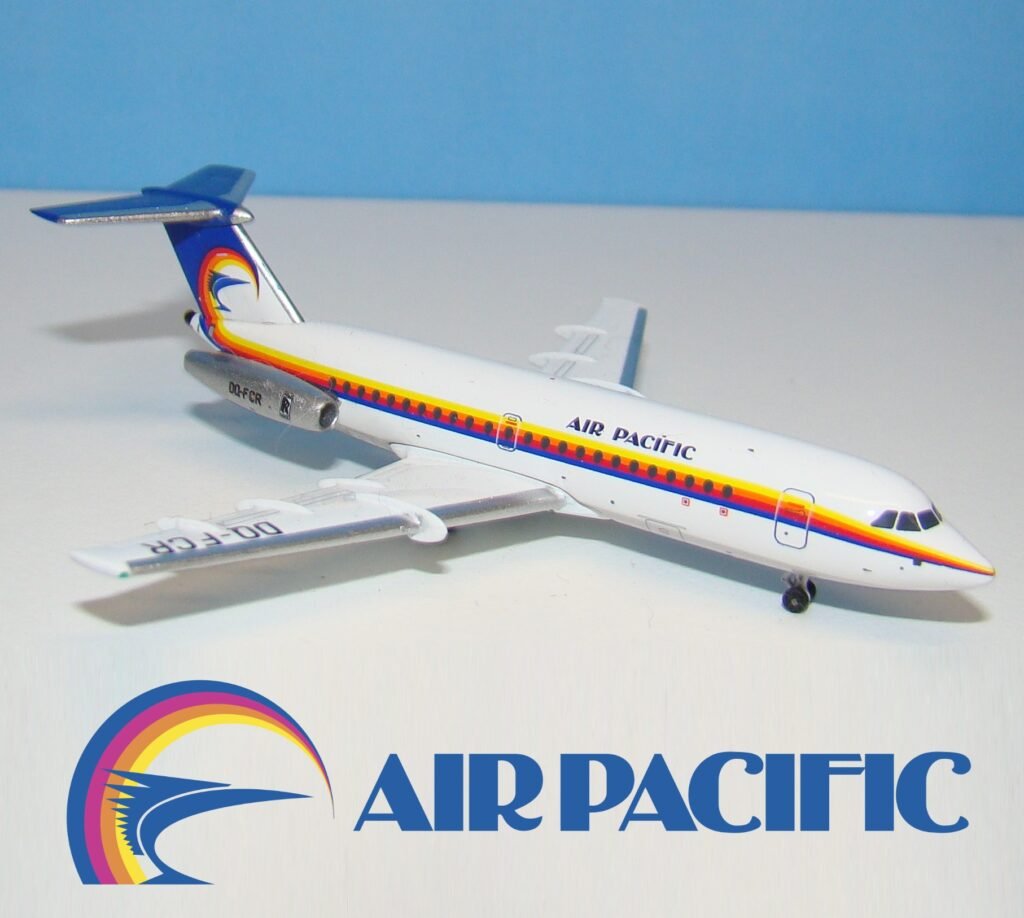
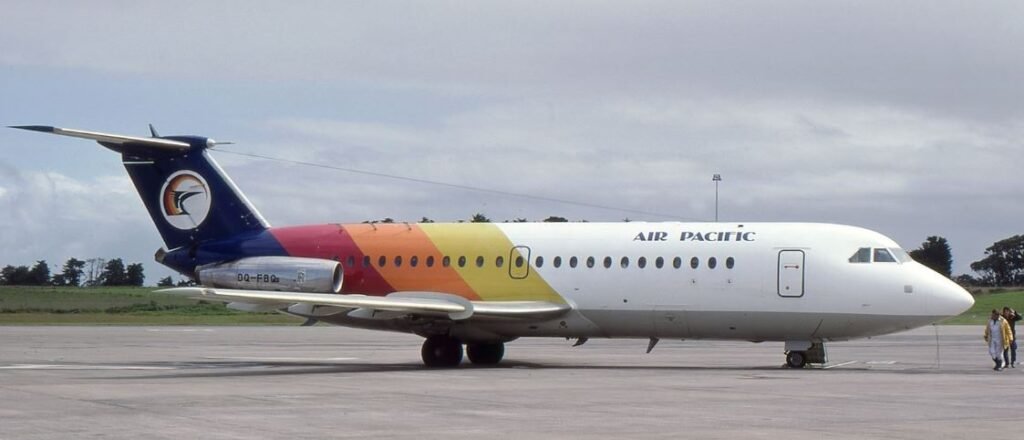
Air Pacific was one of only two customers in the Oceania region to equip itself with Britain’s BAC One-Eleven. Though the One-Eleven was a middling success for a declining British civil aviation industry, by the late-1960s, despite heavy pressure from the British government, it could not compete effectively with the new Douglas DC-9 and Boeing 737-200 on a level playing field. Even so Fiji’s One-Elevens were some of the last built and being specialist series 475s helped Air Pacific reach its often primitively equipped island destinations.
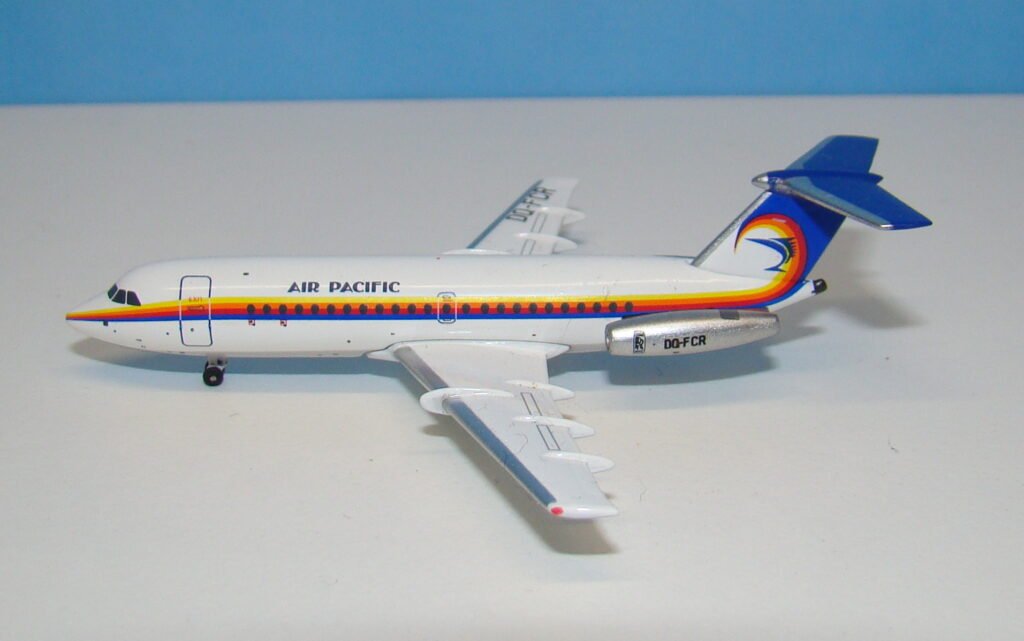
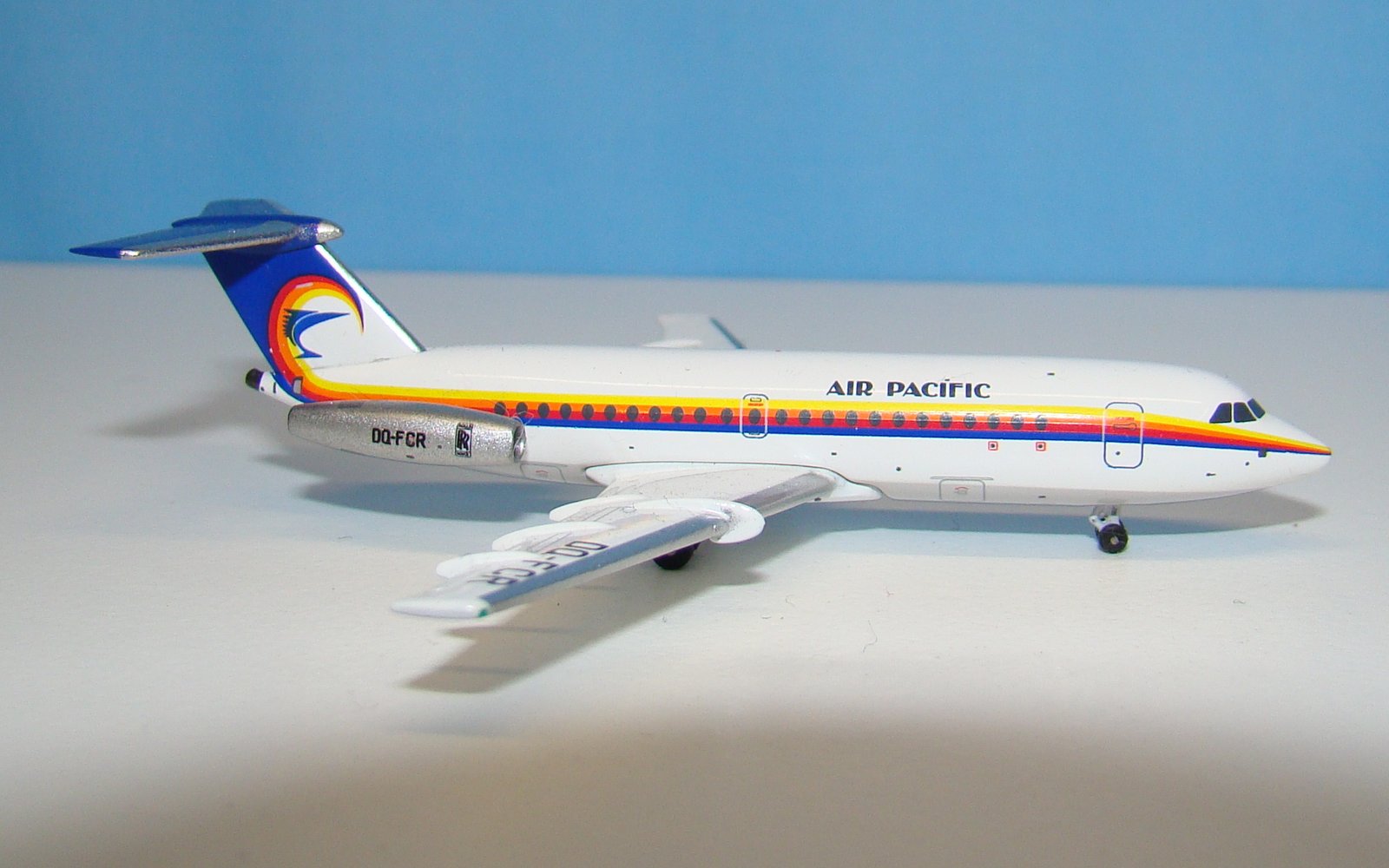
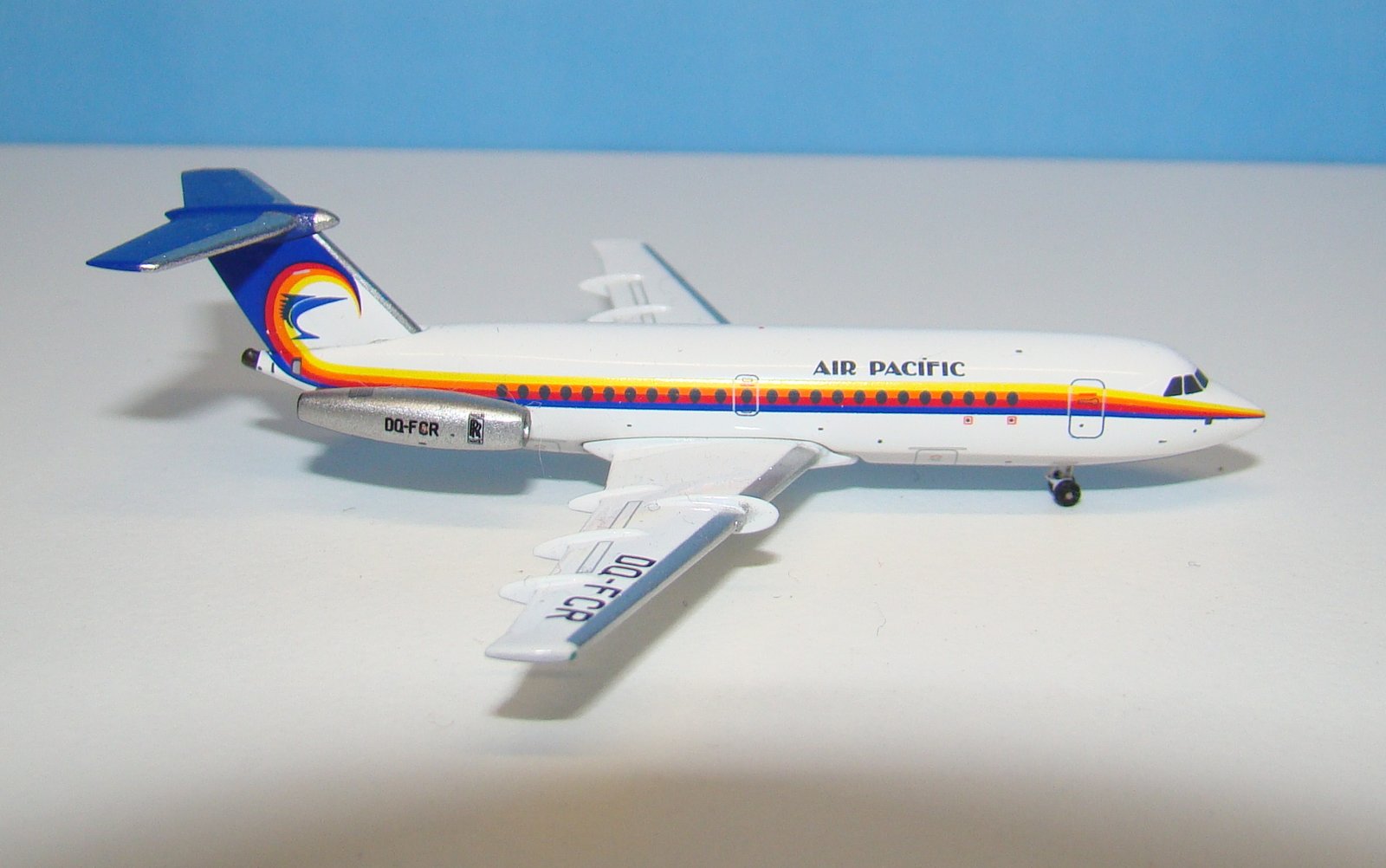
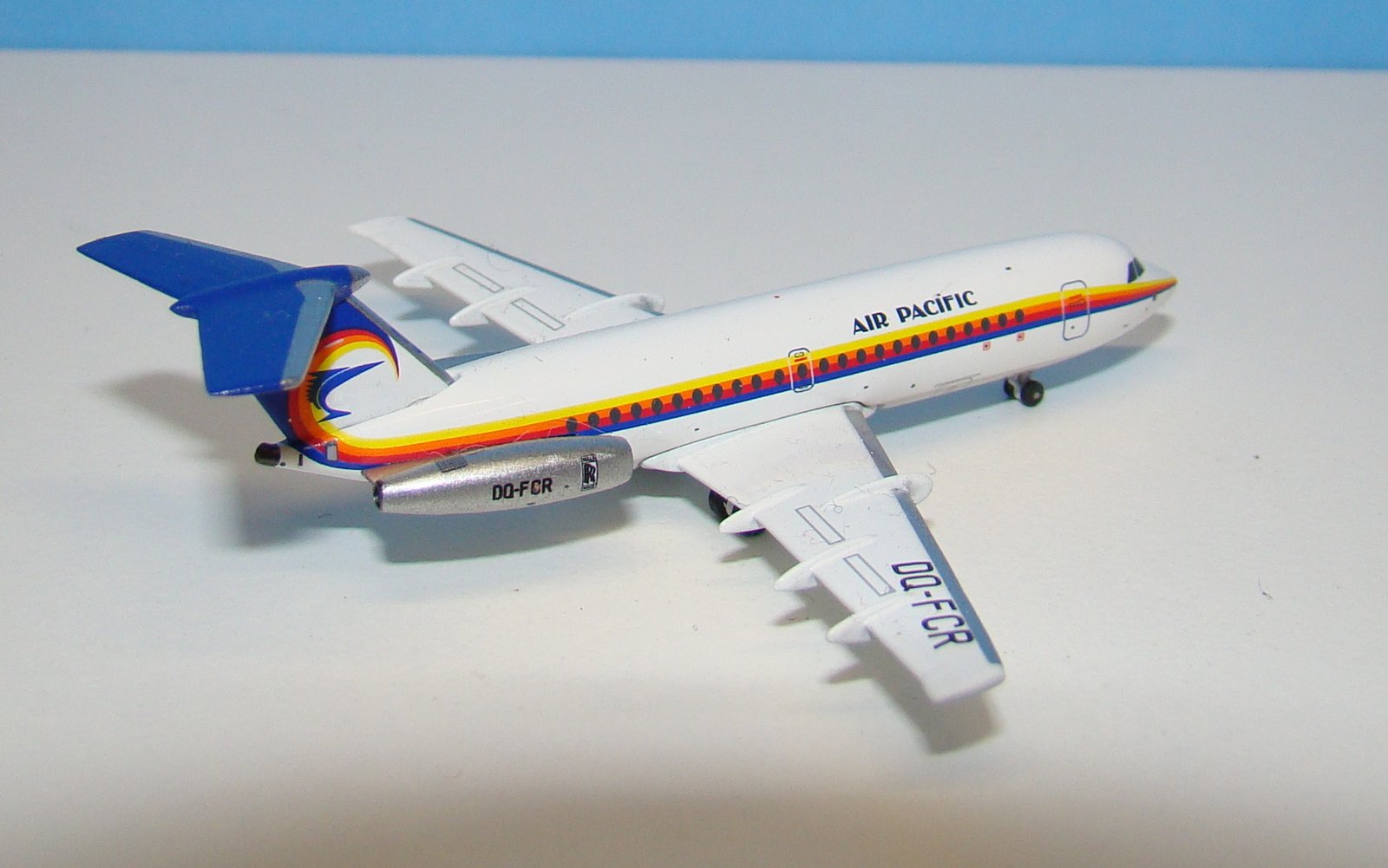
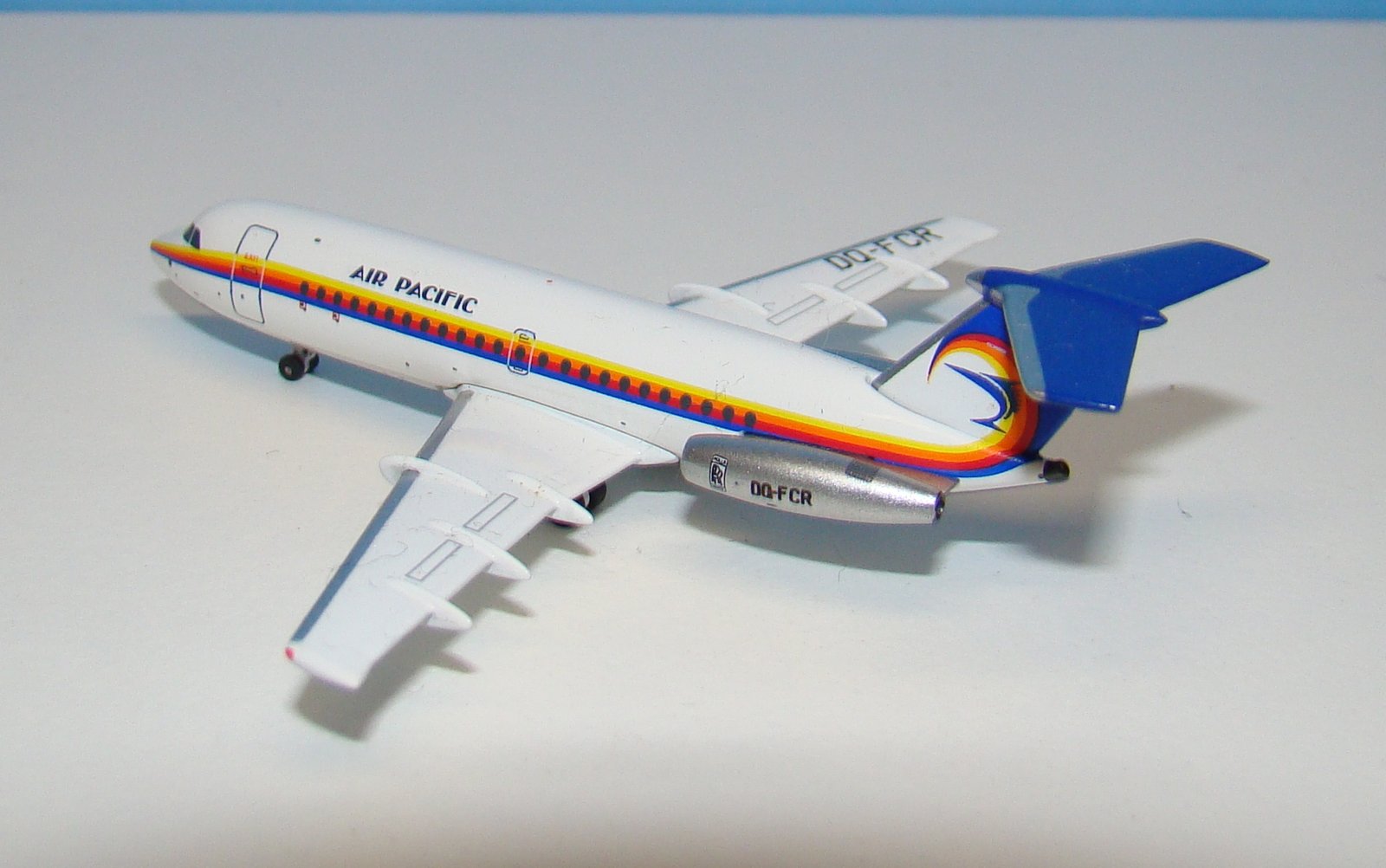
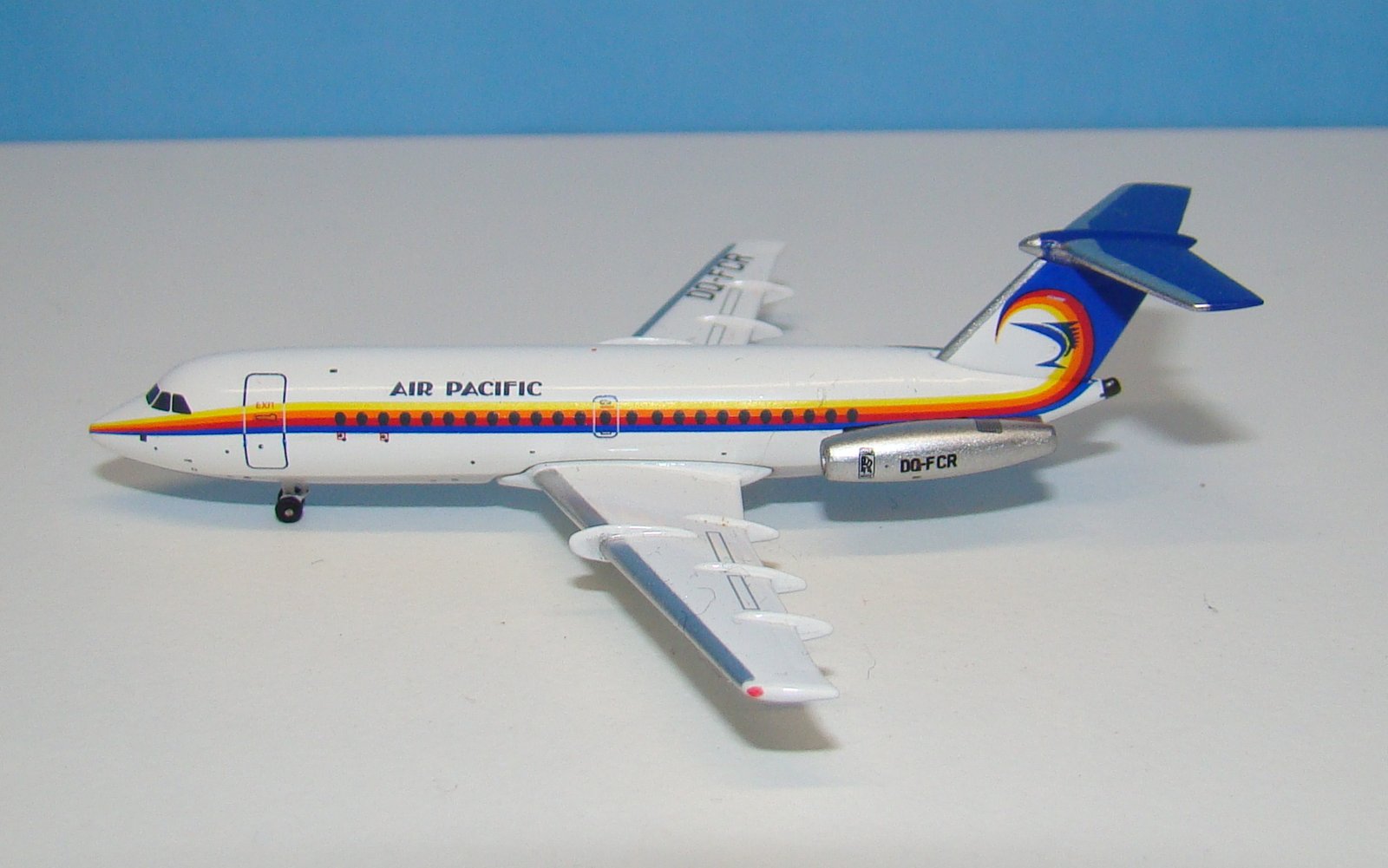
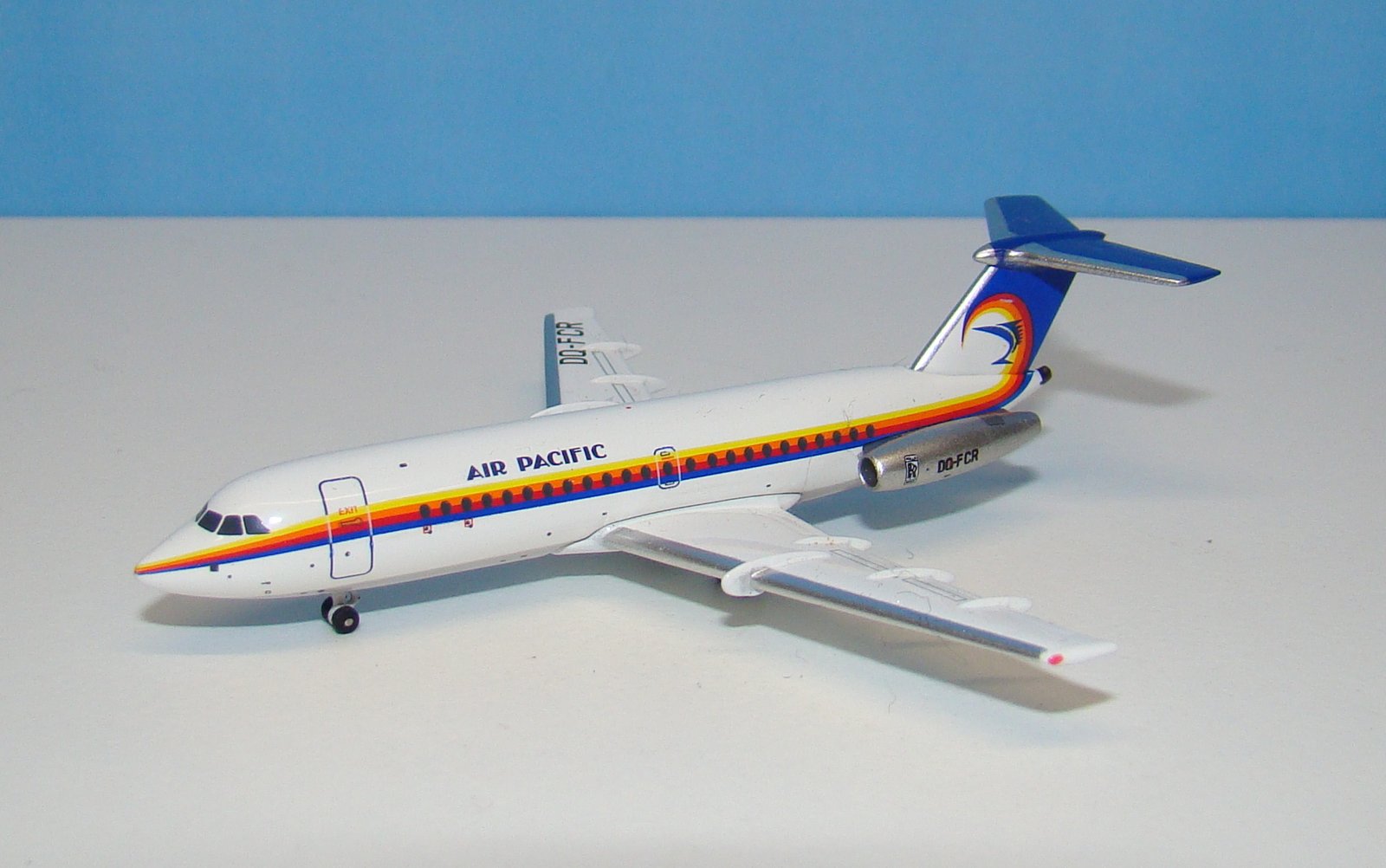
Not having a mould for the 475 series Aeroclassics can only produce the single series 413 DQ-FCR
Orders for One-Elevens in the Pacific were very limited when the airlines resisted interference in their purchasing. In Australia TAA and Ansett fought for the DC-9-30 whilst in New Zealand National Airways Corporation chose the 737. East-West Airlines of Australia did order a single One-Eleven 475 in December 1970, but in the end the aircraft was never delivered. The only exceptions to the whitewash was a pair of series 217EAs delivered in 1968 to the Royal Australian Air Force and a pair of series 479FUs ordered by Fiji’s national airline Air Pacific.
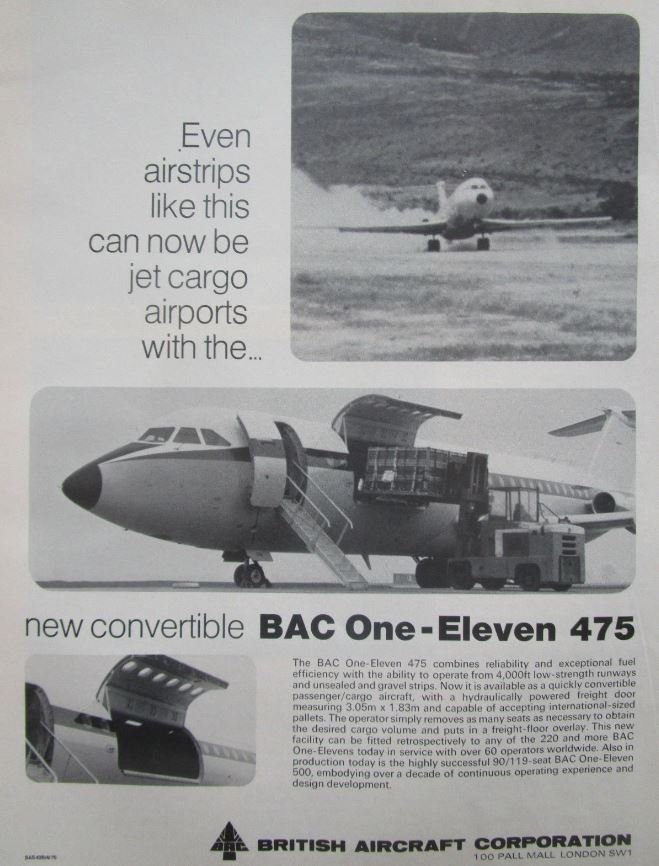
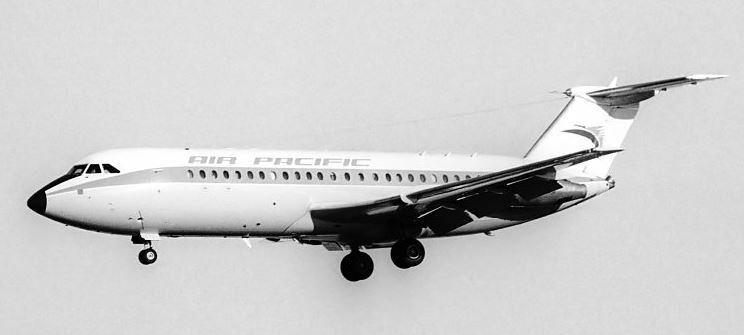
Air Pacific’s One-Elevens were actually some of the last aircraft built, not being delivered until well into the 1970s. In fact they were delivered more than a year apart with DQ-FBQ arriving on March 4, 1972 and DQ-FBV not turning up until August 14, 1973.
The BAC One-Eleven 475 was a new model launched in 1970 using the series 400 fuselage but with the series 500 wing, and an optional rough field kit with strengthened undercarriage and body protection. It was aimed at operations in hot and high conditions and directly as a competitor to the lighter and cheaper Fokker F28. It was a failure and only 11 aircraft were produced. Three went to the Omani Air Force (as series 485GDs), two to Faucett Peru (as series 476FMs), one to Air Malawi (as a series 481FW) and one to a Saudi private customer. Two further aircraft speculatively built by BAC were eventually sold to Mcalpine Aviation in the late 1970s.
FIJI AIRWAYS RAPIDES – AIR PACIFIC ONE – ELEVENS.
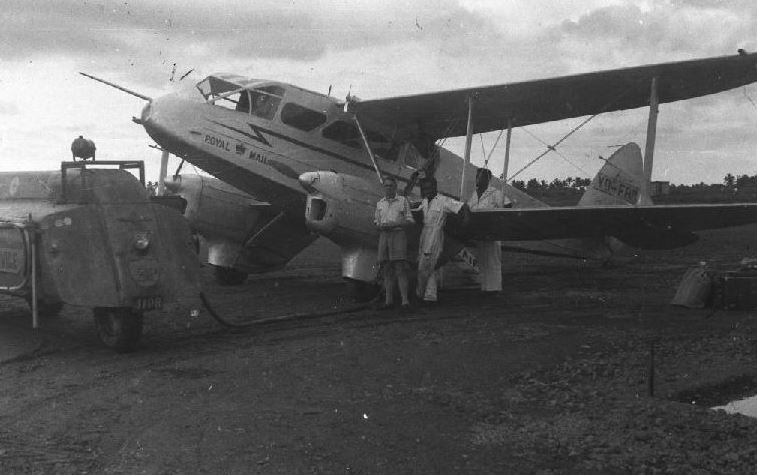
Air Pacific could trace its history back to Fiji Airways that took off for the first time on September 1, 1951 using a 7 seater Dragon Rapide. Qantas acquired the airline in the late 1950s and gradually it was transformed into a multinational regional airline shared by various Pacific nations. In 1966 for example shareholders included Tonga, Western Samoa, Nauru, Kiribati and the Solomons. In 1971 this change of operation was reflected by a new name Air Pacific.
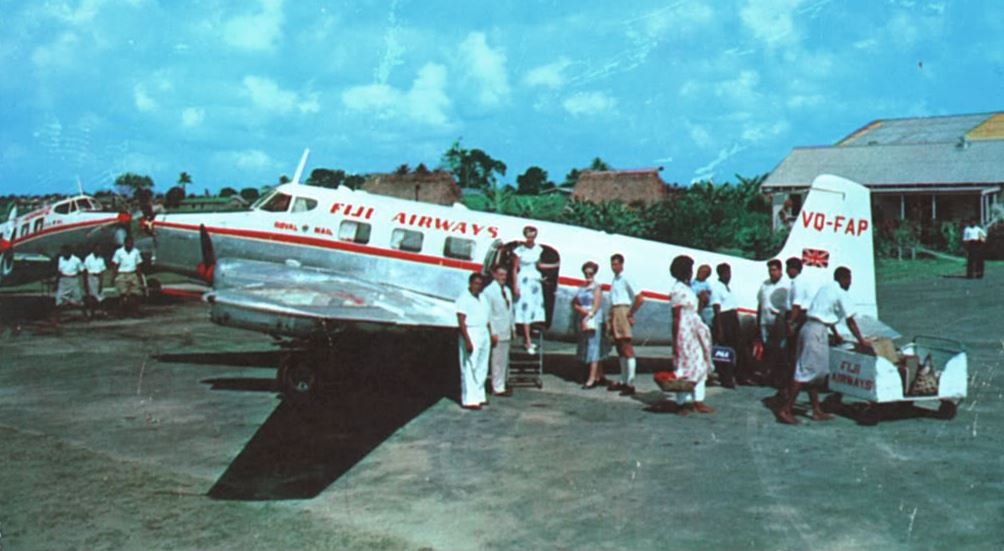
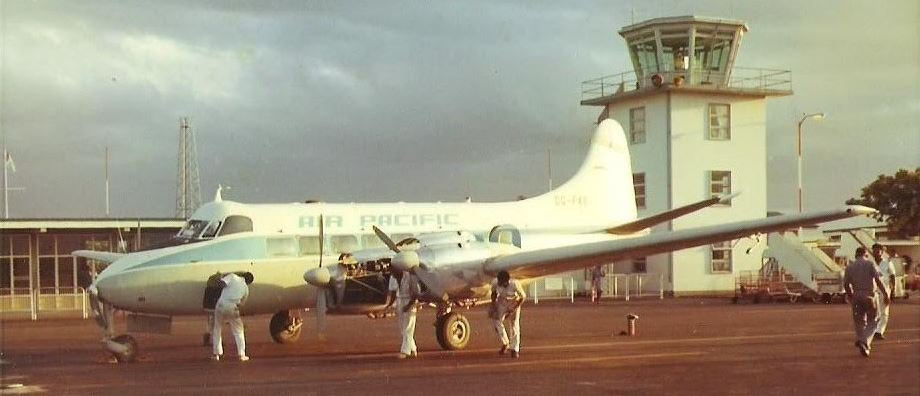
In addition to the Dragon Rapides the fleet had expanded with de Havilland Australia DHA-3 Drovers and de Havilland DH-114 Herons.
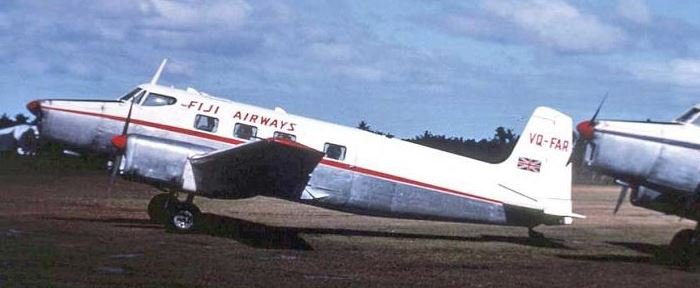
For more information about the uniquely Australian de Havilland DHA-3 Drover see Geoff Goodall’s excellent site here: http://www.goodall.com.au/australian-aviation/drover/drover.htm
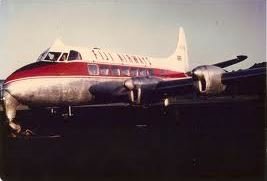
Three Herons were acquired from National Airways Corporation of New Zealand. NAC had been an early operator of the type taking 4 aircraft in 1952/53. They were withdrawn in 1957 after Wellington’s Rongotai airport was upgraded to be able to handle larger types. Three of the four (ZK-BBM-O) joined Fiji Airways becoming VQ-FAY, FAX and FAL. The last two were both written off.
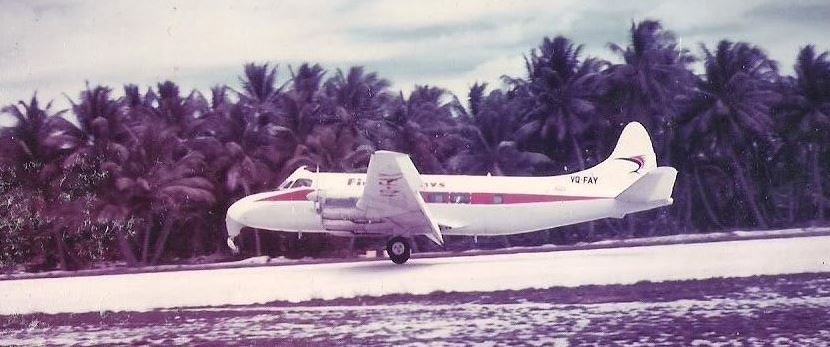
VQ-FAL overran the runway at Ura in Fiji on December 11, 1965 whilst VQ-FAX was written off on November 9, 1966 at Suva. The third aircraft was returned to New Zealand in 1975. It seems another Heron was also operated, an ex-Indian Airlines frame (VT-DHJ), which became VQ-FAC (later DQ-FAC).
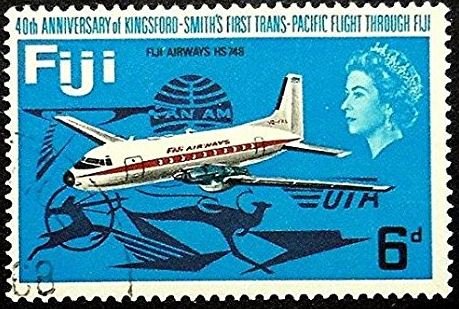
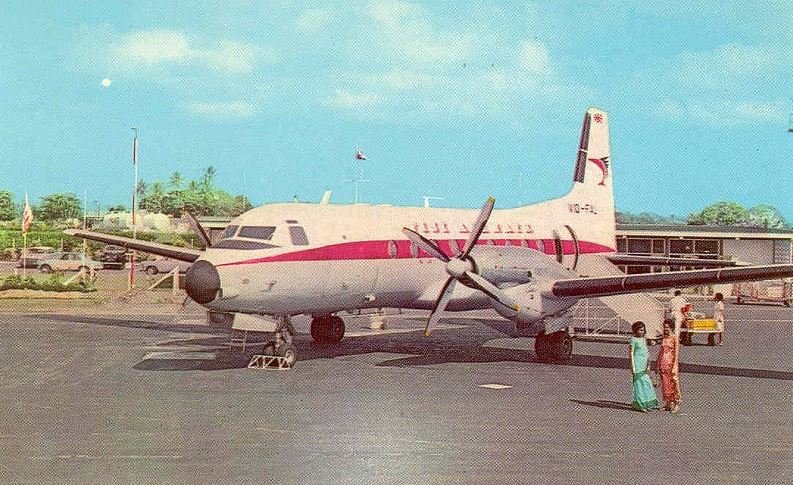
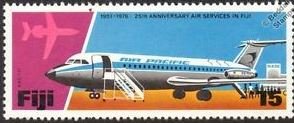
During the 1960s a pair of Qantas DC-3s were also operated and these were seemingly replaced by a trio of new HS-748s from 1967-1969 (VQ-FAL, FBH and FBK). A Beech 99 (N7699N) was also leased from October 1969 from SMB Stage Lines. The new One-Eleven was a major step up for Air Pacific and services began on April 2, 1972 . Not only did it support the HS-748s but for the first time Air Pacific was able to directly reach Australasia.
The first Australasian destination was Brisbane, which was begun on June 1, 1973. This was followed by Auckland and Brisbane via Noumeau in 1975. Previously Air Pacific had bought capacity on Air New Zealand and Qantas services. The second One-Eleven, DQ-FBQ, served a 15 month lease to Air Malawi from July 1974 but the airline was gradually building up its network. In time the One-Elevens were used to operate scheduled services from Suva and Nadi to Apia (Samoa), Auckland, Brisbane, Honiara (Solomon Islands), Noumea (New Caledonia), Pago Pago (American Samoa), Papeete (Tahiti), Port Moresby (Papua New Guinea), Port Vila (Vanuatu), Tarawa (Kiribati) and Tongatapu.
See Ron Cuskelly’s Squawk Ident site about Brisbane Airport Ops here: http://www.adastron.com/squawkid/default.htm
The HS-748s were replaced in 1979 by 3 new EMB-110s (DQ-FCV/FCW/FDF) and in June 1978 a third One-Eleven was purchased. This was a series 413FA which became DQ-FCR. She had originally been delivered to Bavaria on lease in 1968 as G-AWGG but served most of her career with them as D-ALLI ‘Nyphenburg’, with a lease to Gulf Air in 1975. This aircraft actually only saw brief service as it was withdrawn on September 8, 1981 and broken up. This coincided with the delivery the next month of a single new Boeing 737-2X2 from Boeing, which arrived on October 31st. By this time the concept of a pan-Pacific airline had ended and most island nations were starting their own airlines regardless of the financial costs involved. Air Pacific was also struggling and was losing $4-6 million a year by 1981/82; by which time it was busy cost-cutting and reducing staff.
The Fiji government bought out the other shareholder governments around 1984, since they were effectively competing against themselves with their own airlines like Air Vanuatu, Solair and Polynesian. Receiving no subsidies from the Fijian government the airline was given permission to cut loss-making services with other Pacific islands and accordingly the One-Elevens were retired in March 1984 and not replaced. Instead the airline began services to Honolulu as part of ‘Project America” using a DC-10 (see my blog entry about the career of that DC-10 for more details). This was a disaster, cancelled after 14 months and leading to accumulated losses of $20 million by 1985. That year Qantas began a 10 year management contract with the airline and swiftly pulled it back from the brink.
Air Pacific has survived and nowadays trades again as Fiji Airways. The idea of a pan-Pacific airline has still not taken off but most of its competitors are long gone. The BAC One-elevens were important elements in forging a place for Fiji’s airline and well suited to the rough and ready conditions found on the Pacific islands.
References
Hill, Malcolm. BAC One-Eleven. Crowood Aviation Series
1981. Hollie, P. New Pacific Industry: Airlines. New York Times
The BAC One-Eleven & Fokker Jetliners. Air Vectors.net
The Far East. BAC1-11jet.co.uk
DH 114 heron. Kiwiaircraft Images
2004. Air Pacific BAC 1-11. Airliners.net
Skinner, S. 2013. BAC One-Eleven: The Whole Story. The History Press
Our History. Fiji Airways.com
Fij Airways. Funding Universe