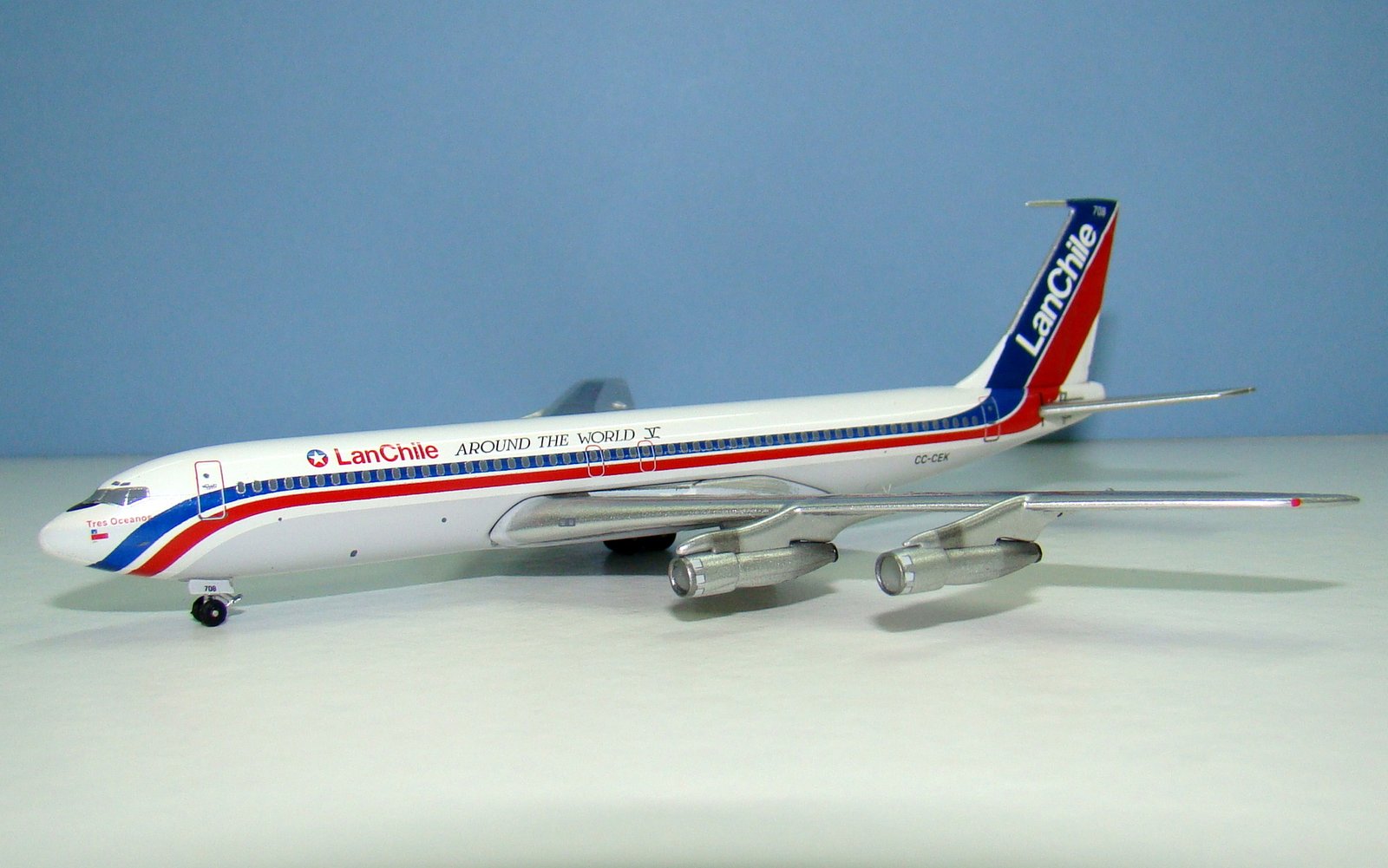
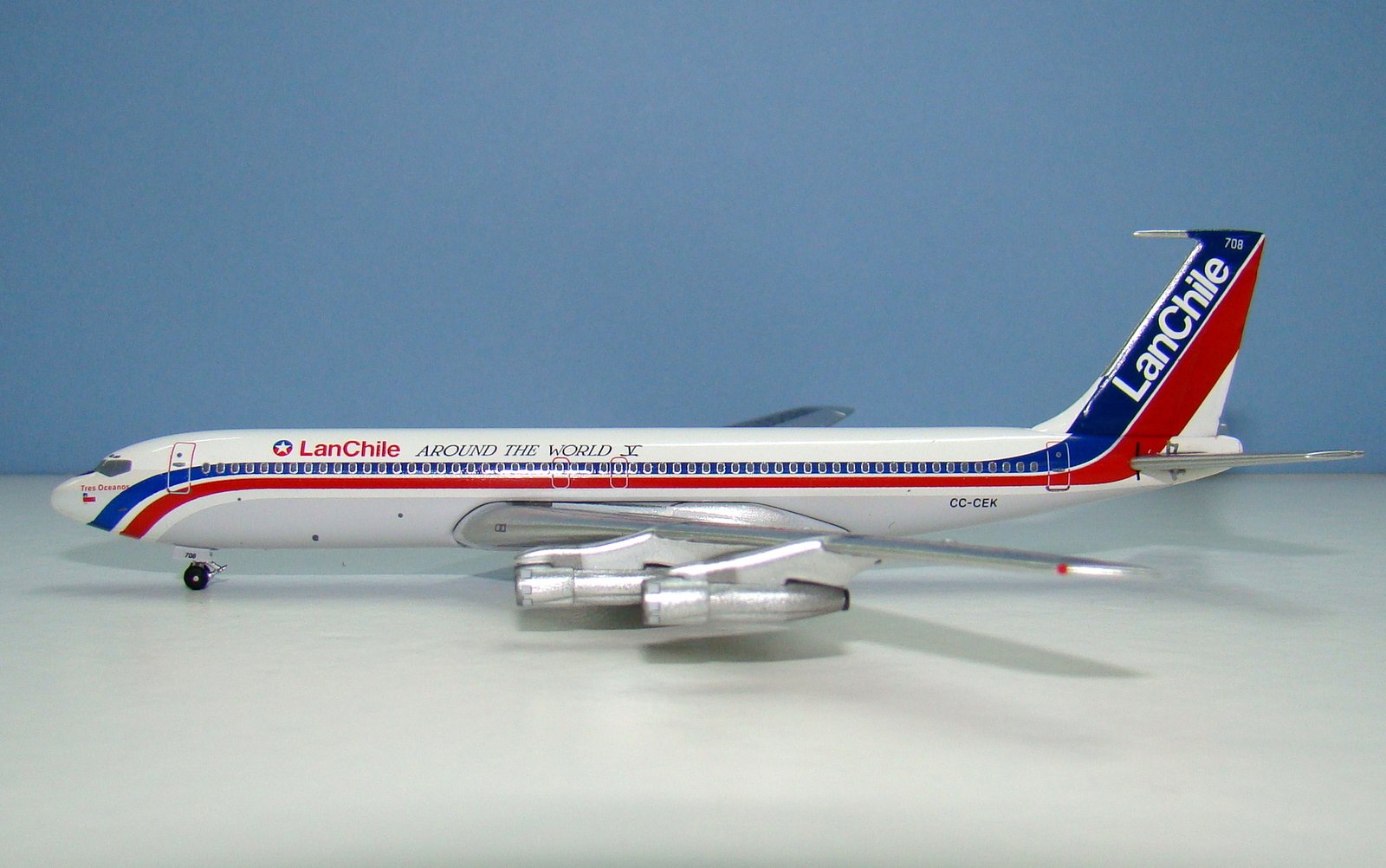
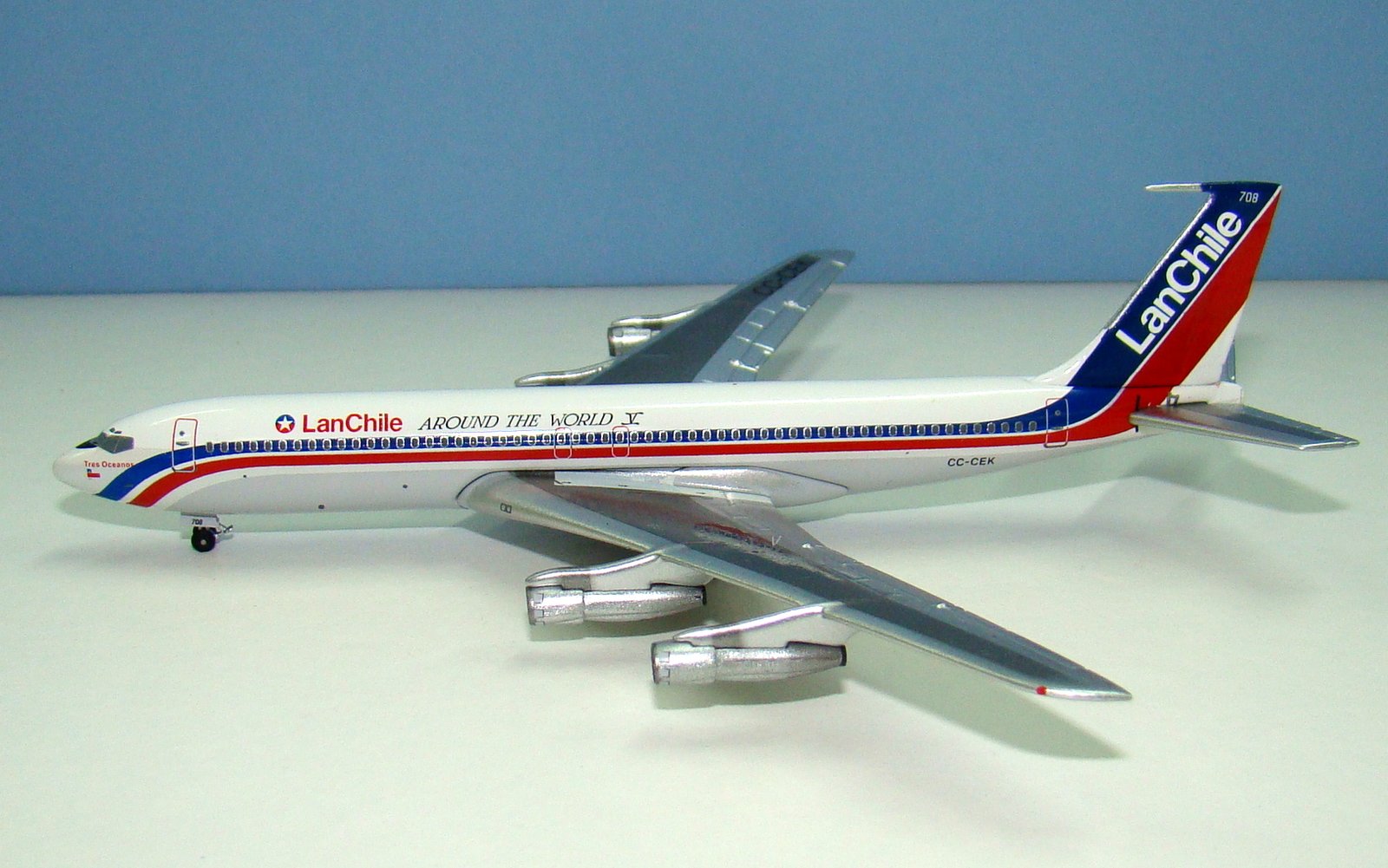
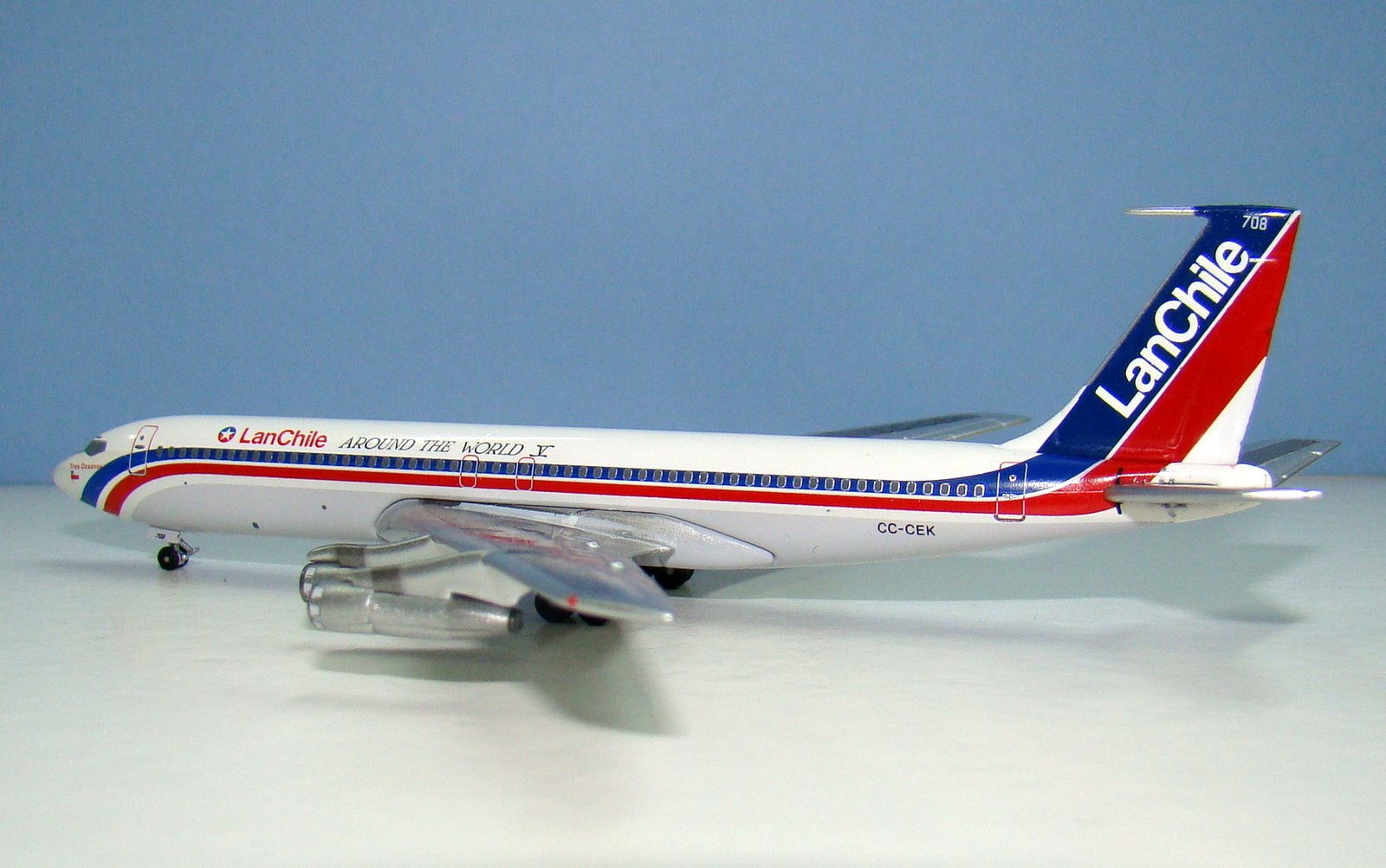
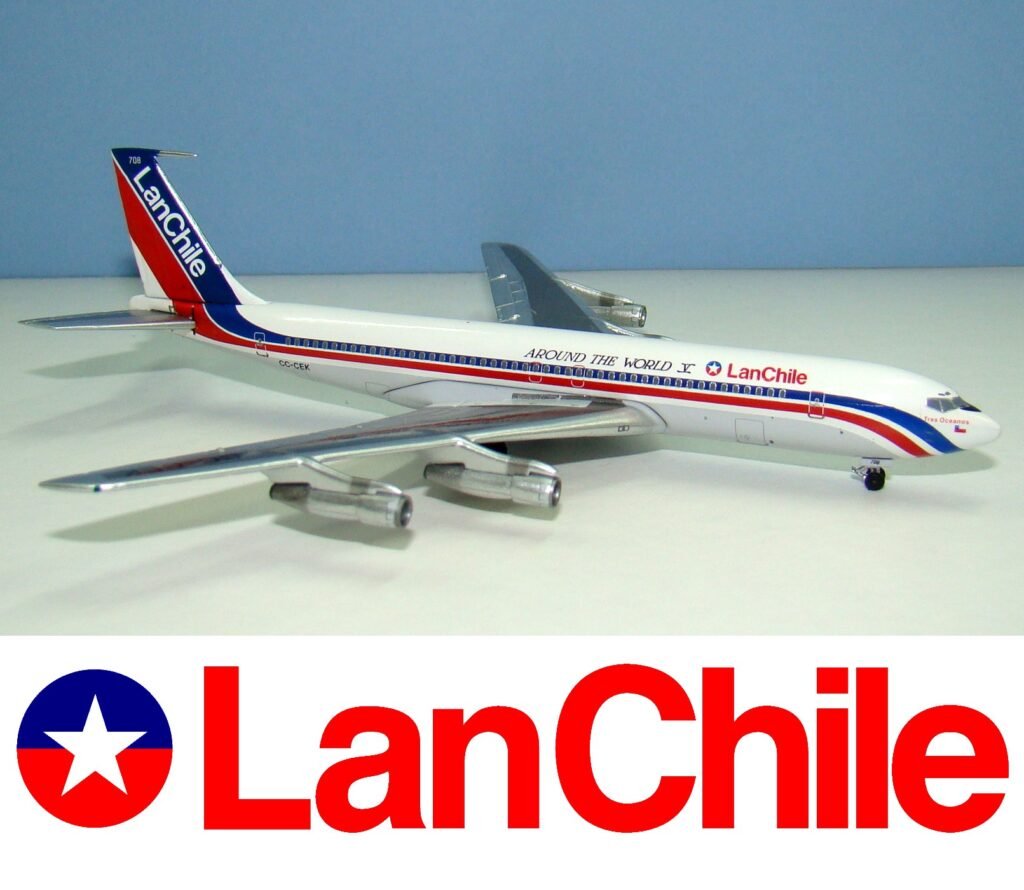
Round the world flights were a feature of several major airlines route networks (Pan Am for example) and at times some airlines had also operated round the world charters to more obscure destinations (TWA did at least one using a 707), however nobody can match the impressive series of Cruceros del Aire (“Air Cruises”) run by Lan Chile between 1985 and 1989.
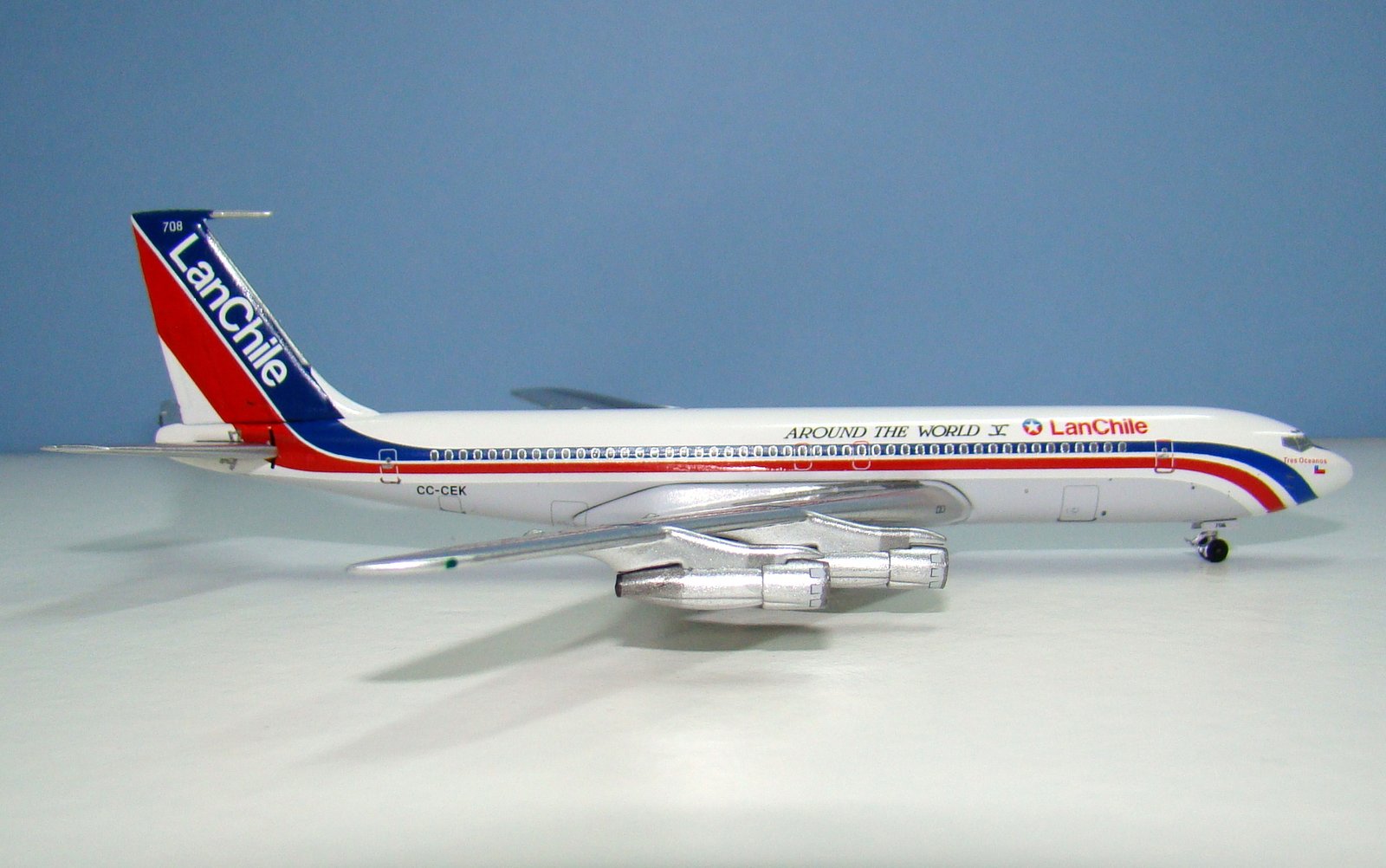
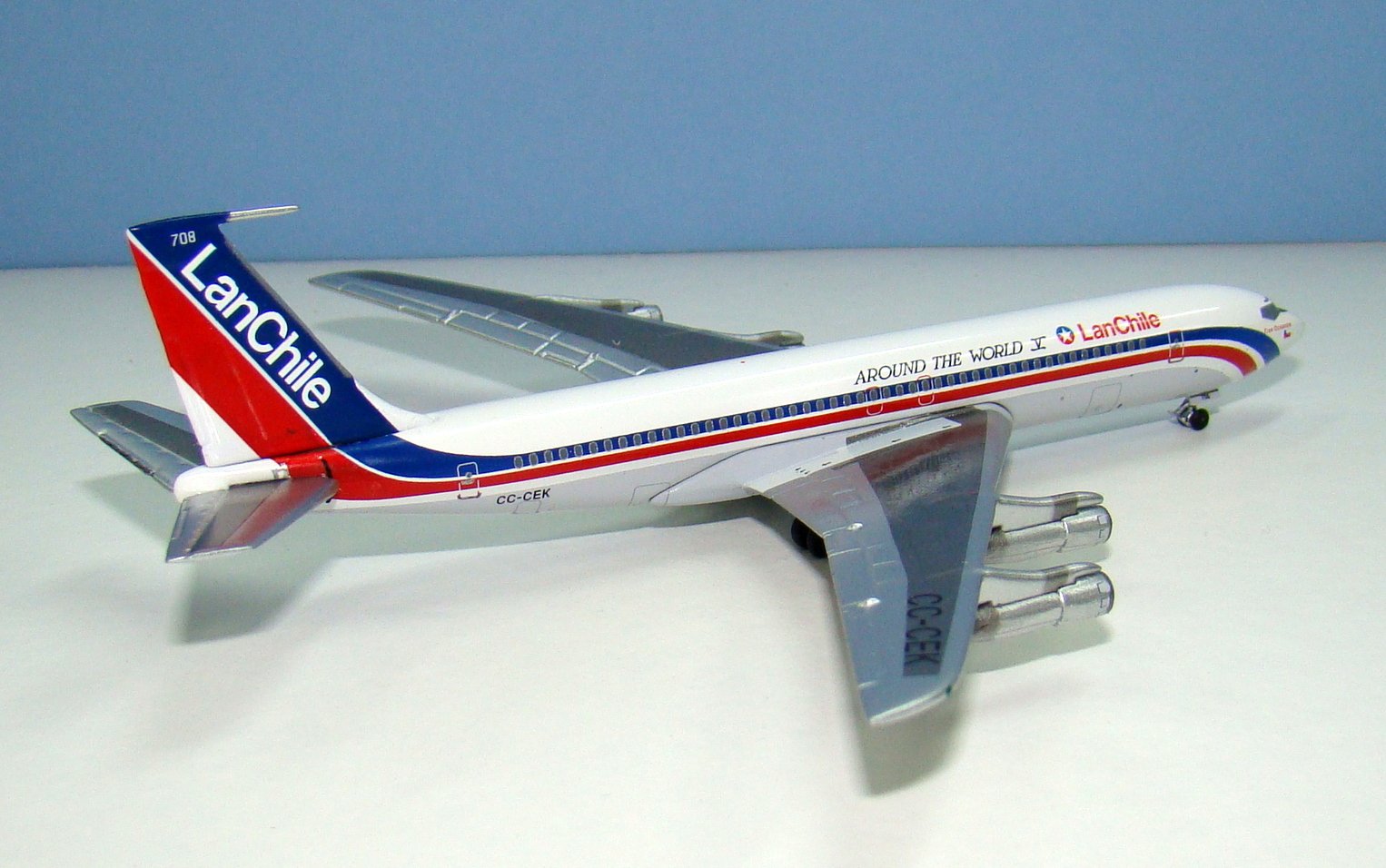
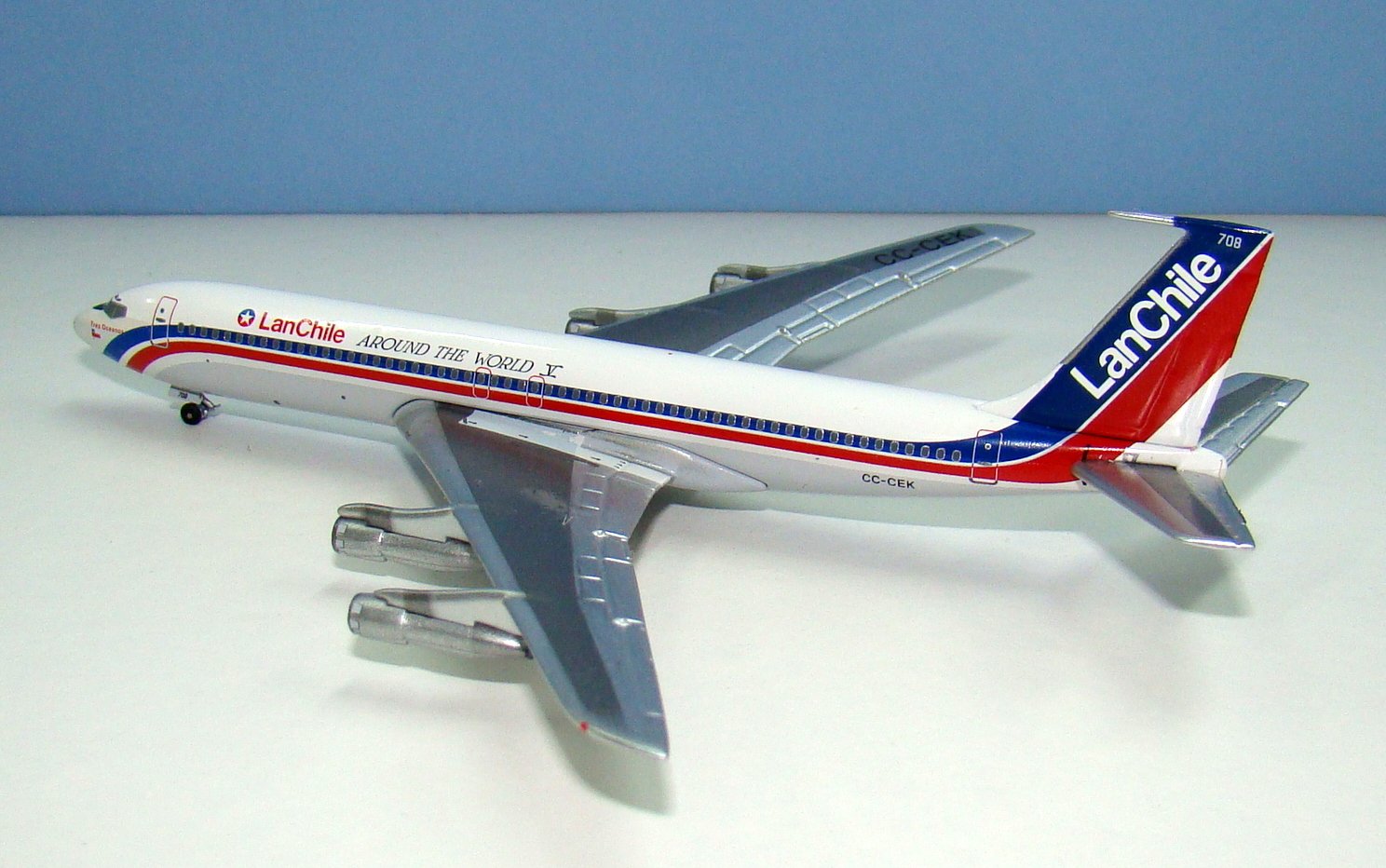
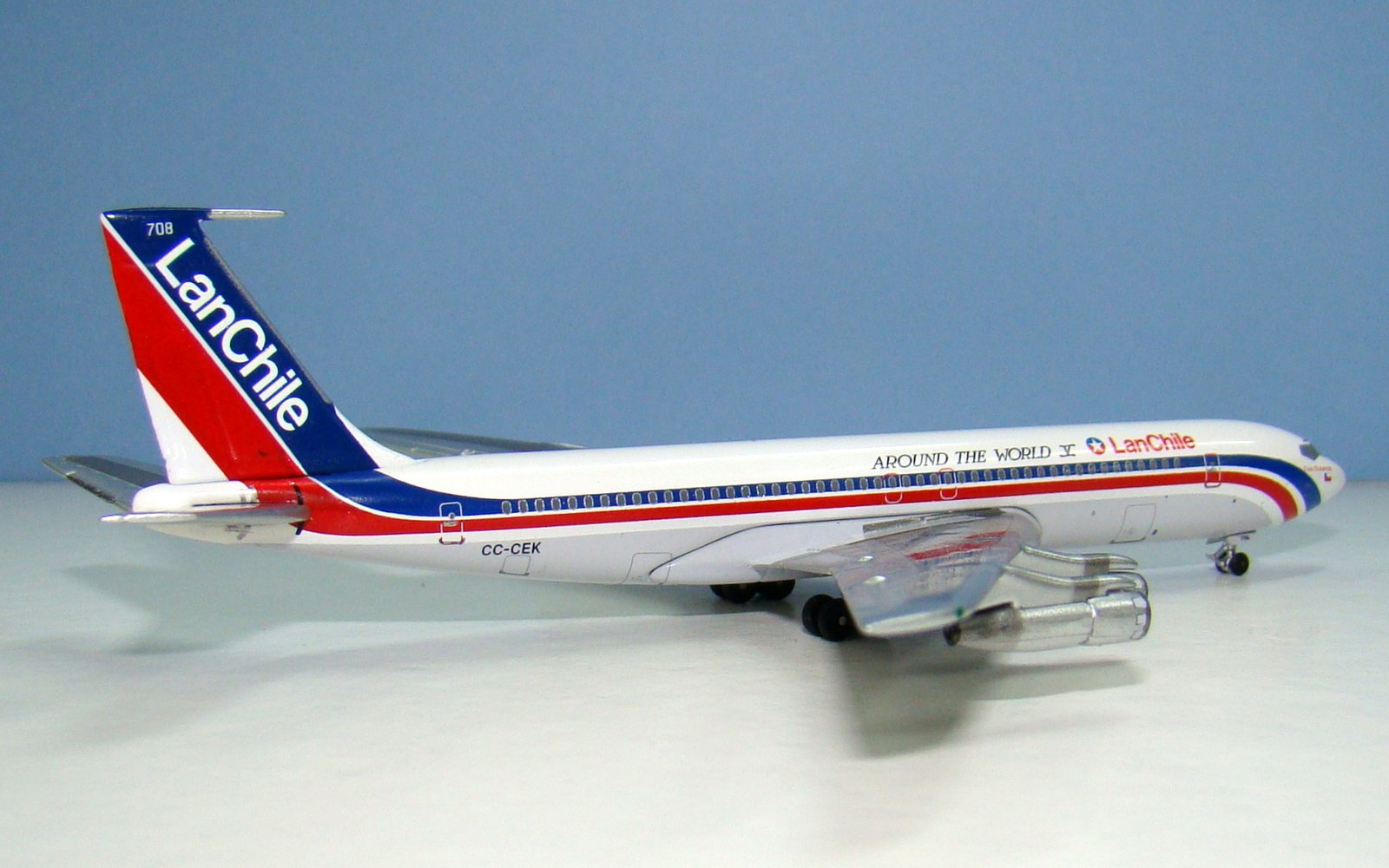
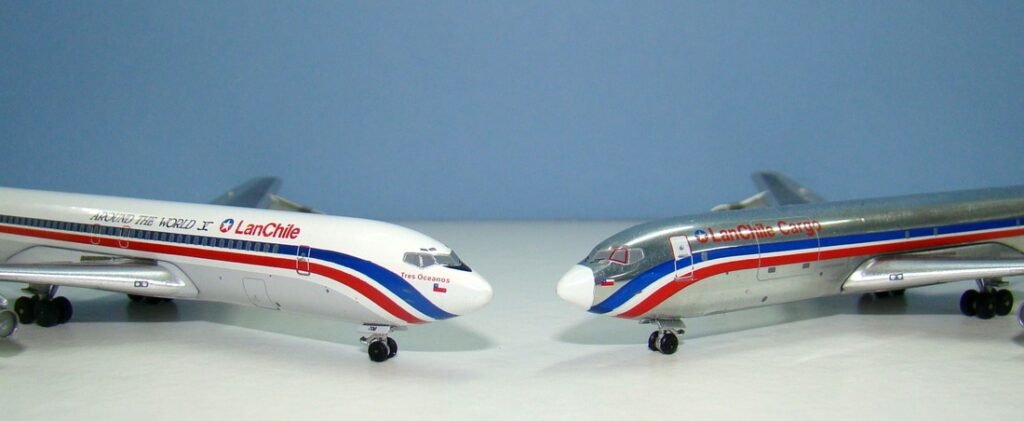
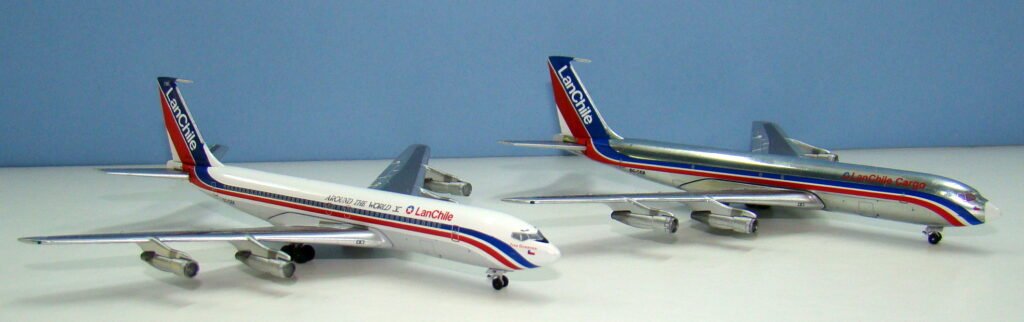
Lan Chile Boeing 707-321B CC-CEK Aeroclassics 1:400 Scale Model Airliner
Chile was at the time coming towards the end of the Pinochet dictatorship and in fact the national airline had only been rescued from oblivion in 1984 when it was effectively re-established following the accrual of hundreds of millions of dollars of debt during the turbulent 1970s and early 80s. With government ownership increased to 98.7% and recapitalisation Lan Chile was able to regain lost marketshare and undertake fleet renewal.
The Boeing 707 still played a role in the passenger fleet in the 1980s. Despite its financial troubles Lan had acquired a range of secondhand examples during the 1970s from Lufthansa, Northwest and Pan Am. One aircraft was written off in 1978 and a pair transferred to the Chilean Air Force in late 1982, but 5 others remained in service despite the introduction of DC-10s and then 767-200s.
Newly reinvigorated Lan was in the mood to celebrate 60 years of operations (29 as an international airline). It decided to do this by undertaking a series of 13 air cruise flights over a four year period using specially outfitted 707s. The cruises were designed to show off the Lan Chile brand globally in markets the airline had never served and act as ambassadors for Chile.
The first two flights occured in 1985 (April 26 and September 27) under the title ‘Project Three Oceans’ and used a Boeing 707-321B which was specially reconfigured to seat 80 first class passengers. Tickets cost $10,000 and the itenarary would last 31 days! The first flight had stops in Buenos Aires, Cape Town, Johannesburg, Nairobi, Mahe Island in the Seychelles, Madras, Singapore, Denpasar, Sydney, Melbourne, Christchurch, Auckland, Papeete and Easter Island, flying over the Atlantic oceans , Indian and Pacific. Hence the initial name of the project.
This photo taken at Auckland in November 1985 suggests CC-CEA was used for the 2nd trip (if going by date) and 1st (if going by titles) too. Photo used with permission of Mike Cornwall from FlickR
The second flight in September, commanded by Commander Leonardo Siña, flew the same routing but omitted the stops in Argentina and India. The omission of the Buenos Aires stop made the first leg to Capetown an 08:51 journey. Most of the passengers on these flights were not Chilean but the flights obviously achieved their aim as for 1986 another four were organised. The third ‘Three Oceans’ flight took off on May 10, 1986 commanded by the captain Sergio Camila in another B707, carrying 77 passengers. Again the routing was broadly similar but with minor changes. The Nairobi stop was omitted but replaced by a stop in Colombo, Sri Lanka.
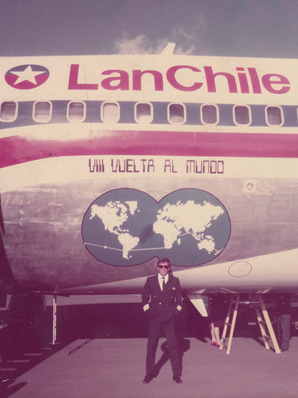
Capt Velasco in front of the aircraft used for the 8th tour
The fourth air cruise was renamed as ‘Vuelta a China’ (Return to China) and for the first time, as the name suggests, included China on the inventory. The 30 day journey routed Santiago, Easter Island, Papeete, Sydney, Hong Kong, Shanghai, Beijing, Manila, Auckland and Punta Arenas. The remaining two tours in 1986 are not well documented but departed on August 30 and October 11. The popularity of the air cruises remained undiminished however and four more were slated for 1987.
Below: CC-CEK seems to have been used for the most (but not all) Air Cruise flights.
Lan Chile Boeing 707-321B CC-CEK Aeroclassics 1:400 Scale Model Airliner
Lan Chile Boeing 707-321B CC-CEK Aeroclassics 1:400 Scale Model Airliner
Lan Chile Boeing 707-321B CC-CEK Aeroclassics 1:400 Scale Model Airliner
Lan Chile Boeing 707-321B CC-CEK Aeroclassics 1:400 Scale Model Airliner
Lan Chile Boeing 707-321B CC-CEK Aeroclassics 1:400 Scale Model Airliner
Lan Chile Boeing 707-321B CC-CEK Aeroclassics 1:400 Scale Model Airliner
Lan Chile Boeing 707-321B CC-CEK Aeroclassics 1:400 Scale Model Airliner
Lan Chile Boeing 707-321B CC-CEK Aeroclassics 1:400 Scale Model Airliner
Lan Chile Boeing 707-321B CC-CEK Aeroclassics 1:400 Scale Model Airliner
Lan Chile Boeing 707-321B CC-CEK Aeroclassics 1:400 Scale Model Airliner
Lan Chile Boeing 707-321B CC-CEK Aeroclassics 1:400 Scale Model Airliner
Lan Chile Boeing 707-321B CC-CEK Aeroclassics 1:400 Scale Model Airliner
The first tour of the 1987 programme was another new routing, known as the ‘Project West-East’. It utilised the CC-CEK once again and was documented by its commander: Cdte. Emilio Velasco. The flight departed on April 13, 1987 as Lan 001. The first stop was a quick 1.5 hours in Easter Island and then onwards to Papeete for 3 days. From Tahiti they went to Sydney (2.5 days), then on to Hong Kong (4 days), Beijing (3.5 days), Shanghai (3 days), Manila (2 days), Auckland (4 days), Easter Island (2 days) and then back to Santiago. Velasco estimated that the total fuel consumption for the trip was 102,900 gallons costing $75,782. Apparently the commander had to carry around $20,000 on him in case of diversions to pay for services.
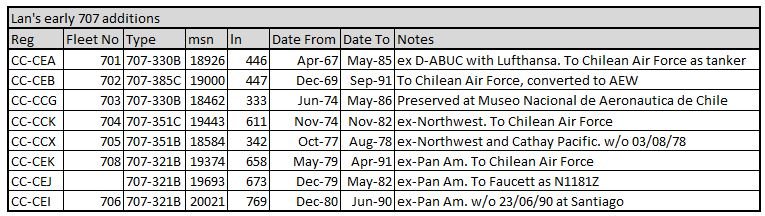
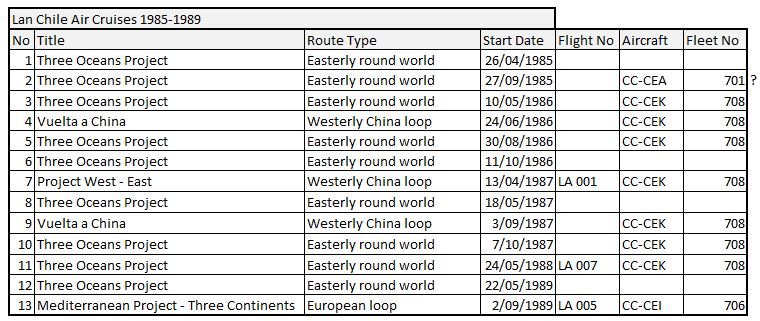
As complete a record of the cruises as I've been able to piece together.
The other three tours for 1987 covered either the Three Oceans or Vuelta a China itenararies but the 707 utilised was equipped with a library and games room. 1988 saw a single service again using the 707 CC-CEK and flown by Capt. Velasco. The flight departed on May 24 on the now familiar routing from Santiago to Cape Town, Johannesburg, Nairobi, Seychelles, Colombo, Singapore, Denpasar, Sydney, Auckland, Papeete and Easter Island returning to Santiago on June 25th. This cruise involved a total consumption of 94,220 gallons of fuel, at a total price of USD 73,084. Of these, USD 5,800 were to be paid cash in Seychelles, USD 5,400 in Colombo and USD 1,000 in Denpasar. The commander was recommended to load the maximum fuel in Johannesburg, Singapore and Papeete, and the minimum in Nairobi, Denpasar and Easter Island.
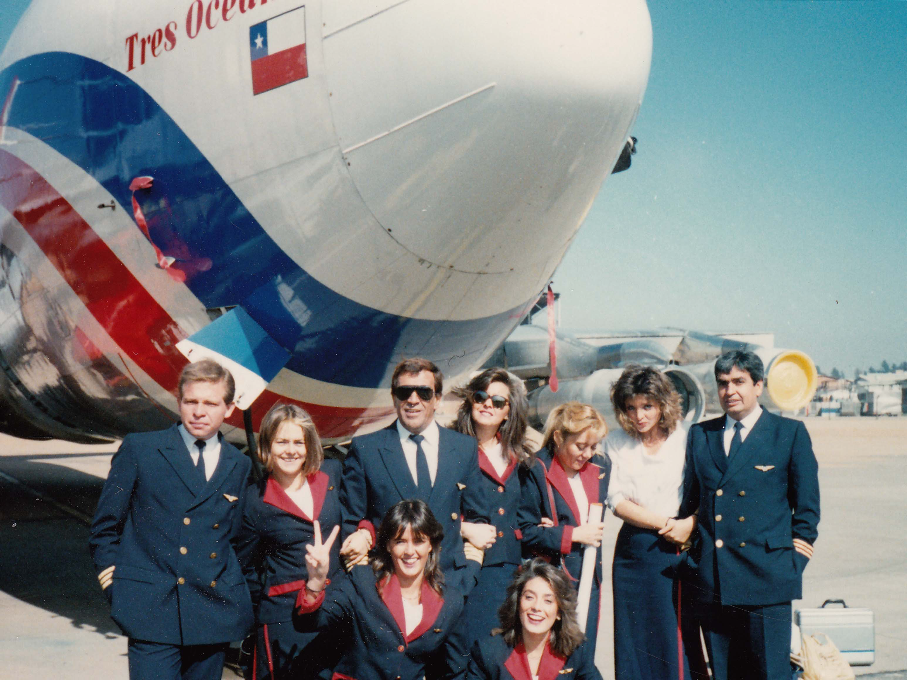
Capt Velasco (centre) and crew in front of probably CC-CEK
The final pair of services were undertaken during 1989. The first was another standard ‘Three Oceans’ trip, which took off from Santiago on May 22, 1989, being commanded by Captain Allan Turner, first officer Rodrigo Sánchez, and engineer of Flight Ricardo Sierra.
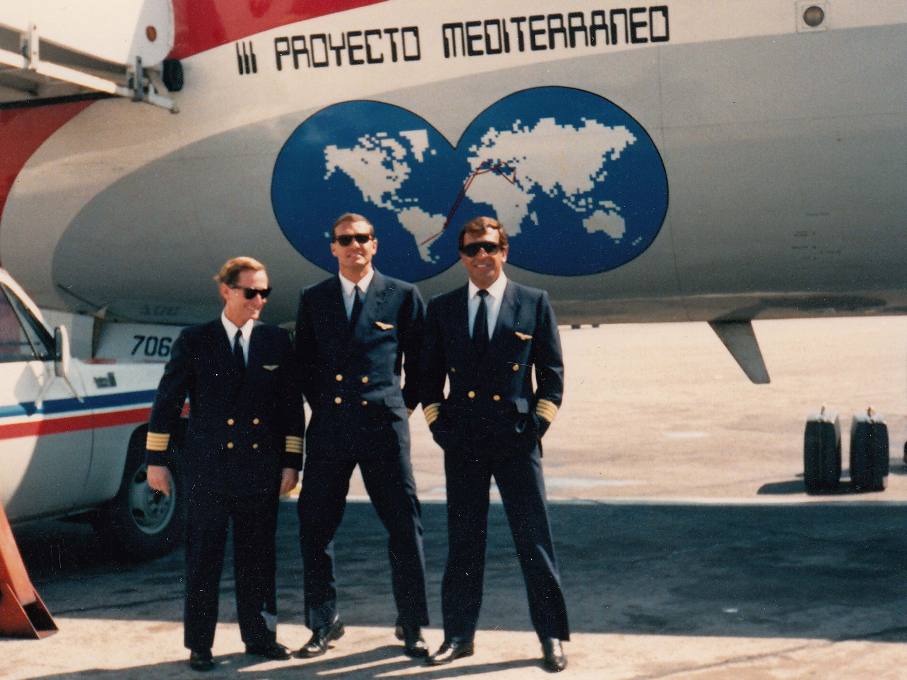
Crew in front of CC-CEI for the Mediterranean project. Captain Velasco at right
The very last service was however something different. It was known as the ‘Mediterranean Project – Three continents’, and for the first time it would include stops in Europe. The itinerary was Santiago – Sao Paulo – Rio de Janeiro – Gerona – Palermo – Catania – Aswan – Luxor – Damascus – Rhodes – Istanbul – Dubrovnik – Marrakech – Rio de Janeiro – Sao Paulo and Santiago. Lan 005 arrived back in Santiago on October 1, 1989 after 29 days away and brought the Air Cruises programme to a successful conclusion. Interestingly this last cruise used a different 707, CC-CEI.
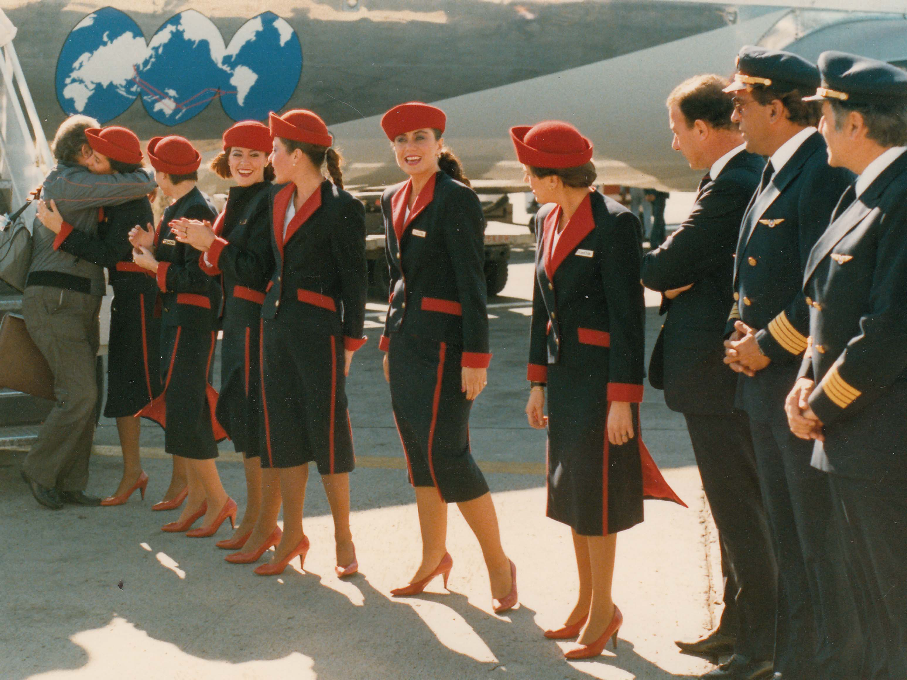
Passengers say goodbye. Judging by the fuselage map this was following one of the China trips
Just prior to landing Commander Emilio Velasco Tornero said goodbye to his passengers and paid fitting tribute to the air cruises saga:
“Good morning friends! And I’m not saying good morning gentlemen passengers, as would be usual in an itinerary flight, because this is a very special flight. We have traveled together in many countries. We have crossed many seas. We have lived 28 days of our lives in something different.
There have been very pleasant moments and we have also felt tired as normal. But I am particularly happy because the mission to get them out of the house and bring them back happy, is being fulfilled. We, the cockpit crew, have once again fulfilled a technical-professional function as on any Lan Chile flight.
But I would also like to point out the work of our good girls and beloved flight attendants who with their sympathy and affection, I believe have made them feel on board, not as guests, but as homeowners.
I also want to highlight the hard work and professional performance of our dear guides Lucía and Huberto. I ask for all of them an affectionate applause.
Well, I say with pity, we are reaching the end of the long day, which although sometimes hard, is sure to leave in a corner of the heart something of nostalgia.
I want to say goodbye with a sincere hug of each and every one of you and tell you not until forever, but until soon. Thank you “
The air cruise programme appears to have largely vanished into history and it’s hard to find a lot of information about, certainly in the English language anyway. It was a serious effort by Lan and a triumph of logistics, operations and endurance. It was also a fitting tribute to the Boeing 707s used for the flights. Of the original 8 707s two (CC-CEB and CC-CEK) survived in service until 1991. That wasn’t however the end of 707s with Lan Chile as 4 other much travelled frames were leased for cargo operations and the last didn’t leave the fleet until July 1994.