The history of African flag carriers is something I always find interesting. Not only are they exotic but they often had lovely liveries and tended to operate small numbers of widebodies, making them rare visitors to select European locations. Plus of course, on the less impressive but just as interesting side, they often have histories rife with state interference, graft and civil war. Air Gabon certainly ticks many of these boxes.
The Gabonese Republic, as Gabon is properly known, is one of the smaller African nations and nowadays still has a small population of only about 2 million. It also has a high GDP per capita (the 4th highest in Sub-Saharan Africa) yet due to the all to frequent income inequality the majority of the population remains poor. This last sentence rather encapsulates the story of many African countries and hints at the poor leadership that often blights them and their national carriers.
Air Gabon's unique and quirky parrot logo
As always, the development of aviation goes hand in hand with the political scenario so it is worth understanding that first. The area that is now Gabon was, since 1910, one of the four territories of French Equatorial Africa but became independent on August 17, 1960.
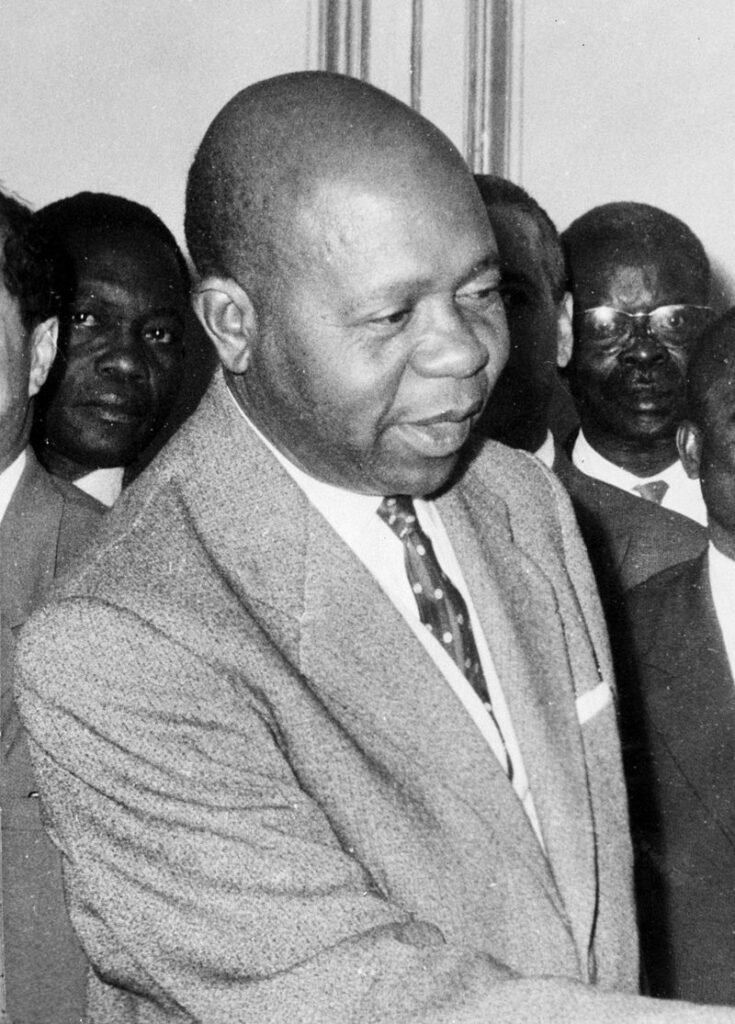
All too quickly the first President of Gabon, Leon M’ba became dictatorial and shamefully he was kept in power by the French government following their intervention in a 1964 coup.
The man Gabon's 747 was named after. President Leon M'Ba. See page for author [CC BY-SA 3.0 nl (https://creativecommons.org/licenses/by-sa/3.0/nl/deed.en)]
M’ba’s successor, after his death from cancer in 1967, was Omar Bongo Ondimba He declared a one-party state in 1968 and unsurprisingly Bongo was ‘re-elected’ continuously afterwards. Reform did not begin until the early 90s and you get the sense the country has never shaken off the impact of the M’Ba and Bongo dynasties.
Gabon had had an airline of its own since 1949 when Jean-Claude Brouillet formed Compagnie Transport Aériens du Gabon (TAG or TransGabon) using mainly Dragon Rapides. TAG evolved a partnership with Air France and following independence in 1960 a trio of ex-Air France DC-3s were acquired as the airline changed its name to Compagnie Aérienne Gabonnaise.
A colourful TransGabon DC-6 in 1972. John M. Wheatley [GFDL 1.2 (http://www.gnu.org/licenses/old-licenses/fdl-1.2.html) oder GFDL 1.2 (http://www.gnu.org/licenses/old-licenses/fdl-1.2.html)]
Unfortunately for Brouillet on June 26, 1961, Gabon joined the fledgling multi-national flag carrier Air Afrique and his hopes for international services were dashed. Transgabon was sold to UTA in 1964 and Brouillet left the company to sail his yacht.
In July 1968 Transgabon was nationalized and renamed Societe Nationale Transgabon (SNT). It continued its growth as an internal airline using a varied fleet, which included DC-4s to Cessnas and Bell 47s. SNT’s chance to fulfil Brouillet’s dream of international services wouldn’t come until 1977 when Gabon somewhat acrimoniously left Air Afrique in December 1976.
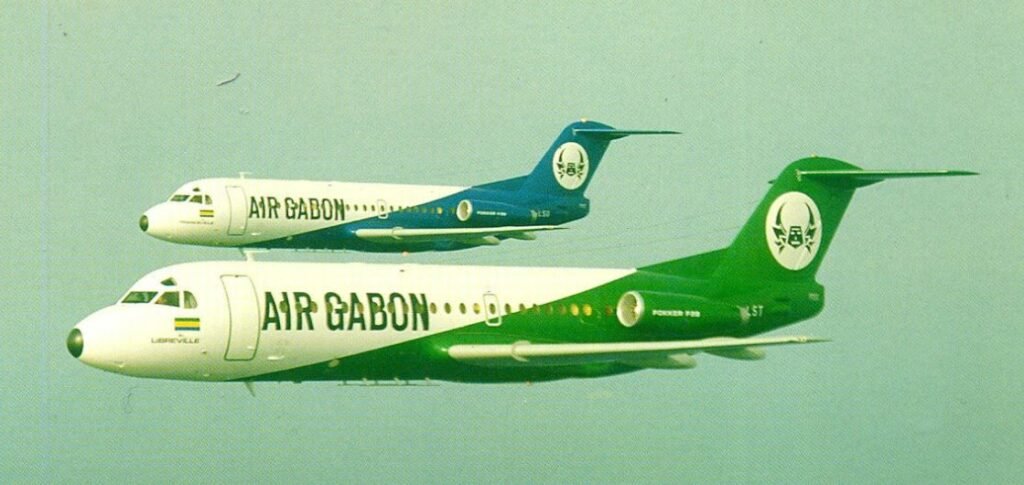
The F28s delivered in 1974 initially wore this scheme with the TransGabon logo on the tail. Presumably the Air Gabon titles weren't added until 1977?
In May 1977 SNT was converted into Compagnie Nationale Air Gabon (or Air Gabon for short) with ownership split between the government (70%) and Sofopag (30%). Sofopag was a French firm controlled by Air France. The fleet consisted of 3 F28s, 2 DC-6As, a DC-4, a DHC-5 Caribou and a Caravelle. Gabon’s intention was to fly its own long-haul services and the cornerstone of this was the acquisition of a single Boeing 747-200 Combi. As part of the same order a single 737-2Q2C was also acquired new from Boeing.
A single 737, TR-LXL, was acquired at the same time as the 747. She served with Air Gabon until its collapse in 2006. Michel Gilliand [GFDL 1.2 (http://www.gnu.org/licenses/old-licenses/fdl-1.2.html) or GFDL 1.2 (http://www.gnu.org/licenses/old-licenses/fdl-1.2.html)]
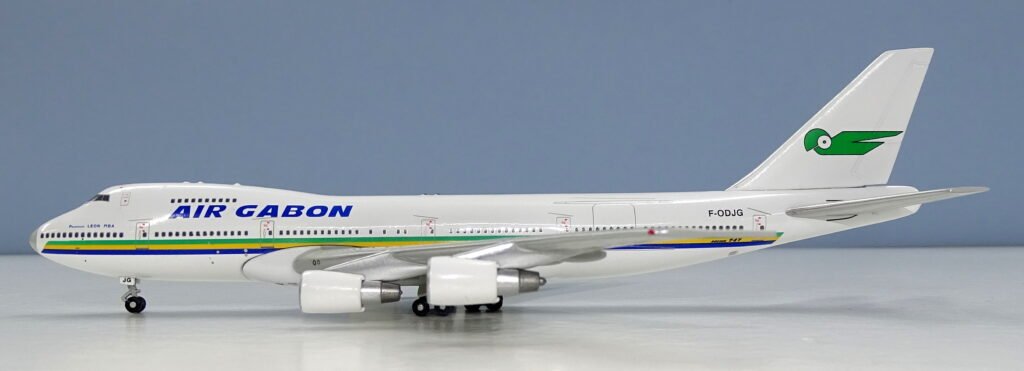
The 747, registered F-ODGJ, and named after the nation’s first President Leon M’ba, was acquired on a lease purchase agreement and joined in October 1978. Prior to that Air Gabon leased an MEA 747-200B, OD-AGJ, between June 1977 and May 1978.
Gabon's first 747 was MEA bird OD-AGJ leased for a year. Note the metal belly. Here she is at Paris CDG in 1977. Michel Gilliand [GFDL 1.2 (http://www.gnu.org/licenses/old-licenses/fdl-1.2.html) or GFDL 1.2 (http://www.gnu.org/licenses/old-licenses/fdl-1.2.html)]
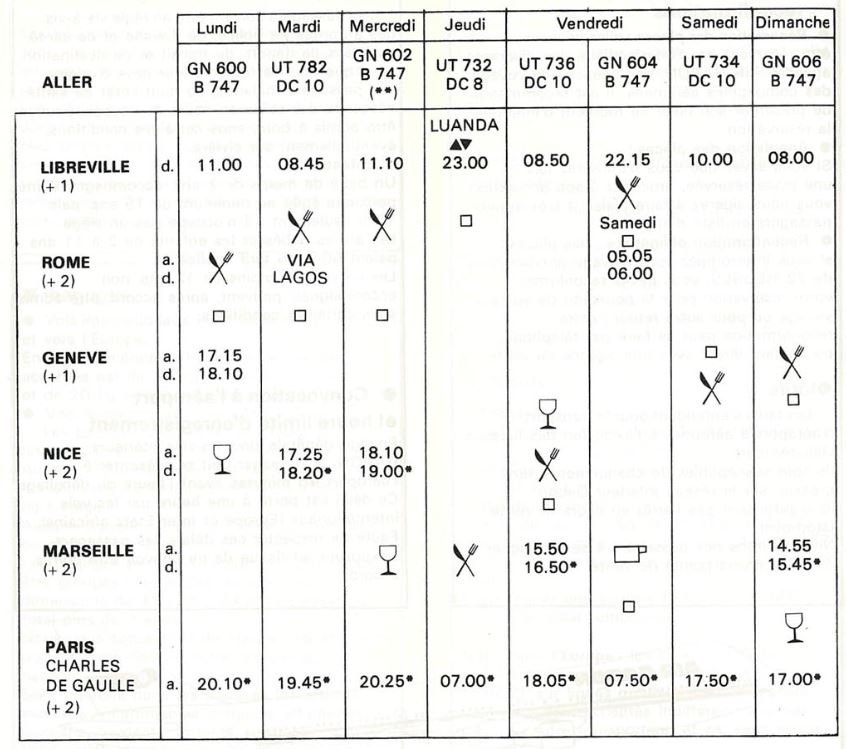
The Lebanese 747 initiated long-haul service to Paris four times weekly via either Marseille, Nice, Rome or Geneva. On Monday’s the 747 left the Gabon capital Libreville at 11am and flew via Geneva, on Wednesday it was Nice, Friday it was Rome and on Sunday it was Marseille. O the other days of the week the route was flown by UTA DC-8s or DC-10s with both airlines operating on Friday giving a total of 8 weekly Libreville-Paris flights.
The original outward bound 1977 joint Gabon 747 and UTA timetable
Right from the start Air Gabon was not a money maker. Between 1977 and 1980 the airline made a loss of 9.449 billion Cameroon Francs (CFA Francs), which was more than four times its capital assets.
Ex-Eastern Air Lines DC-6B, a 1956 build, served as TR-LXN and wasn't withdrawn until 1979 and her sistership LXM survived until 1984. Michel Gilliand [GFDL 1.2 (http://www.gnu.org/licenses/old-licenses/fdl-1.2.html) or GFDL 1.2 (http://www.gnu.org/licenses/old-licenses/fdl-1.2.html)]
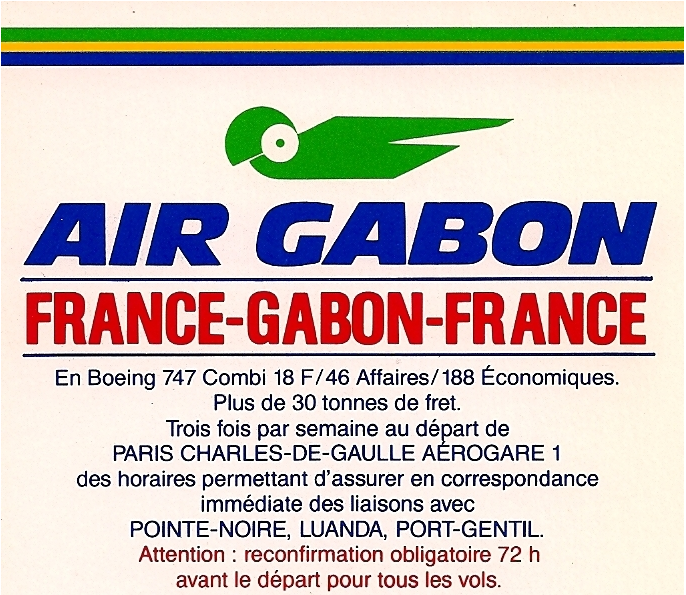
This advertises the 747s 18 First Class, 46 Business Class and 188 Economy Class layout plus 30 tonnes of freight.
The single 747 continued to fly the same route structure throughout the 1980s but it seems the carrier was a focus of graft and overstaffing. Recapitalisation was required in 1986 and this saw the government’s share increase to 80%. At about the same time the 747 was paid off and symbolically transferred to the Gabon register as TR-LXK, although it doesn’t appear that the actual aircraft’s registration was ever altered from F-ODJG.
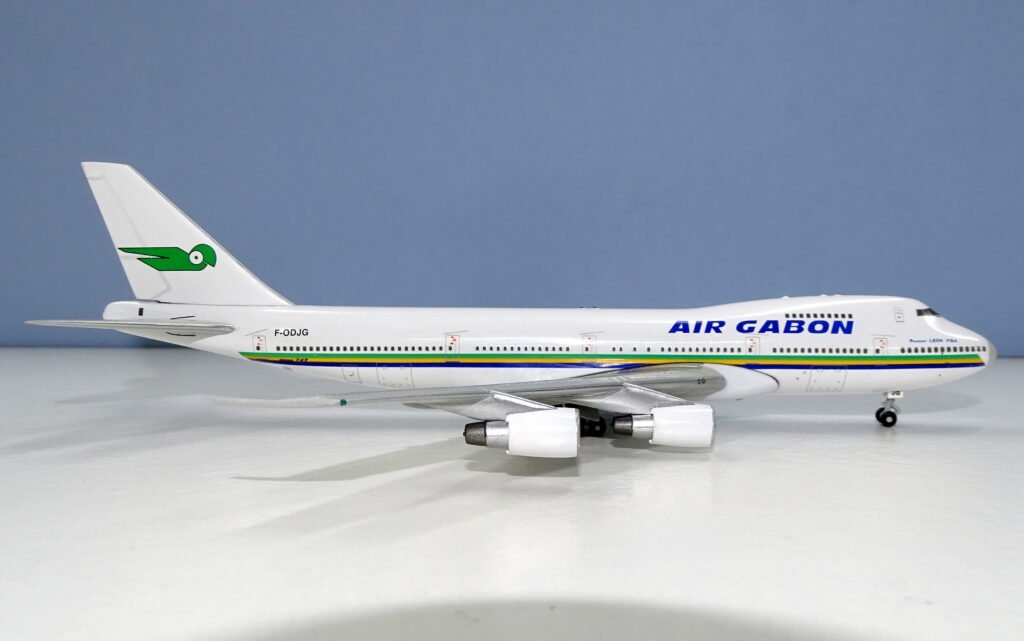
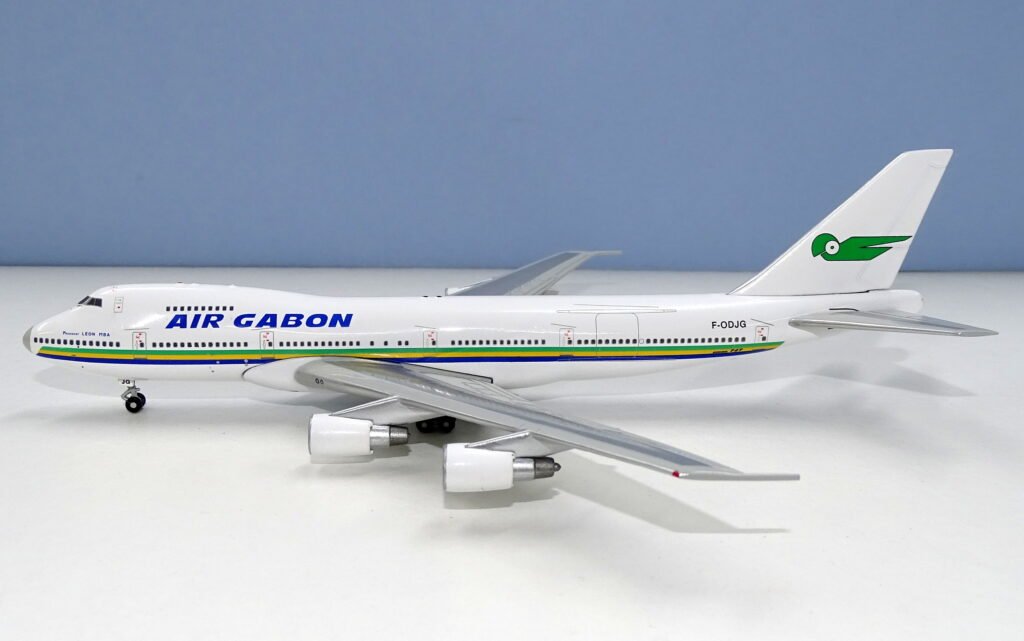
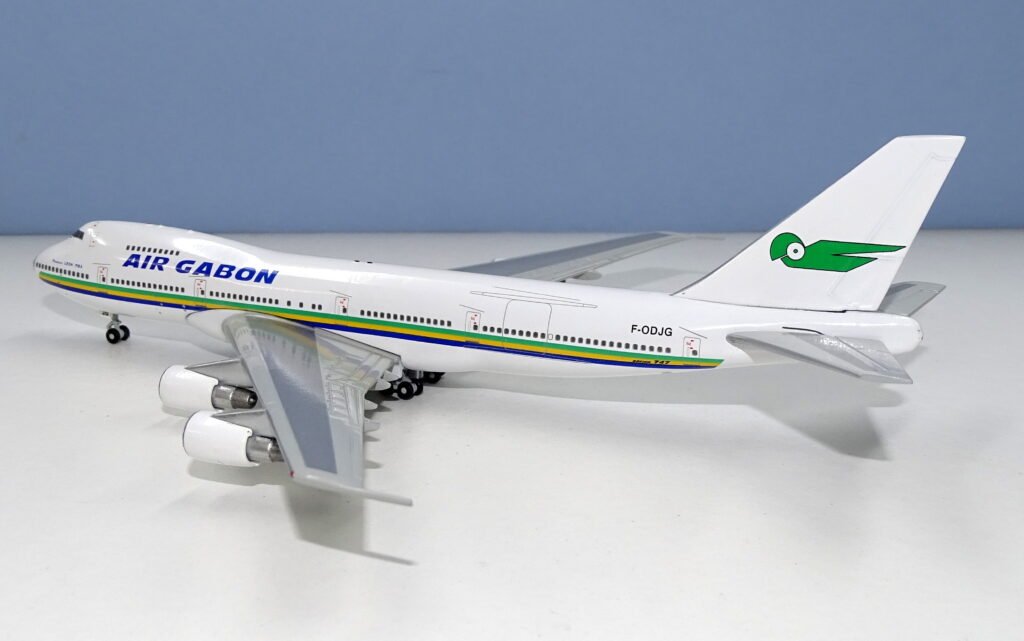
Air Gabon Boeing 747-2Q2BM F-ODJG Magic Models 1:400 Scale Model Airlinerv
Air Gabon Boeing 747-2Q2BM F-ODJG Magic Models 1:400 Scale Model Airliner
Air Gabon Boeing 747-2Q2BM F-ODJG Magic Models 1:400 Scale Model Airliner
Air Gabon Boeing 747-2Q2BM F-ODJG Magic Models 1:400 Scale Model Airliner
Air Gabon Boeing 747-2Q2BM F-ODJG Magic Models 1:400 Scale Model Airliner
Air Gabon Boeing 747-2Q2BM F-ODJG Magic Models 1:400 Scale Model Airliner
Air Gabon Boeing 747-2Q2BM F-ODJG Magic Models 1:400 Scale Model Airliner
Air Gabon Boeing 747-2Q2BM F-ODJG Magic Models 1:400 Scale Model Airliner
Air Gabon Boeing 747-2Q2BM F-ODJG Magic Models 1:400 Scale Model Airliner
Air Gabon Boeing 747-2Q2BM F-ODJG Magic Models 1:400 Scale Model Airliner
Air Gabon Boeing 747-2Q2BM F-ODJG Magic Models 1:400 Scale Model Airliner
Air Gabon Boeing 747-2Q2BM F-ODJG Magic Models 1:400 Scale Model Airliner
The fleet remained fairly stable during the 1980s. It consisted of the single 747, one 737-200, a trio of Fokker 28s and a Lockheed Hercules. The Herc replaced a pair of Vickers Vanguards, which themselves had replaced the DC-4s and DC-6s.
Gabon’s wealth primarily stems from oil revenue but this has not been well managed and in fact the Paris Club and International Monetary Fund (IMF) both have criticized the government for overspending on off-budget items, over-borrowing and slipping on the schedule of administrative reforms.
The 1992 Air Gabon network
This surely had a knock-on impact at Air Gabon. Nonetheless the airline expanded its international network in the mid-90s with services to London using the 747 in 1996. This service was actually another unusual routing, starting not in Libreville but actually in Johannesburg. From South Africa the 747 stopped at Libreville, London-Gatwick and then Paris once a week.
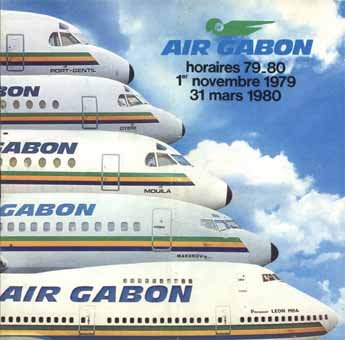
The 1980 timetable was very attractive. Image from the collection of Bjorn Larsson of timetableimages.com
The carrier was still making massive losses (16,345 billion CFA Francs in 1994) although austerity measures had reduced this to ‘only’ 1.643 billion by 1996. Unfortunately, the airline was unable to turn itself around and towards the end of the 90s Air Gabon’s annual debts increased to a staggering level – 37 billion CFA Francs by 1999.
F-ODJG in 1988. AlainDurand [GFDL 1.2 (http://www.gnu.org/licenses/old-licenses/fdl-1.2.html) or GFDL 1.2 (http://www.gnu.org/licenses/old-licenses/fdl-1.2.html)]
All of this was in spite of a 1995 restructuring plan forced on the airline by the IMF and World Bank. Jacob Cabinda, the airline’s Commercial Director, said the following illustrating some of the issues:
“The general directorate has initiated a policy intended to pare down an overstuffed work force and encourage voluntary separations. In addition, many public servants who had been incorporated into the company structure will be encouraged to return to their former agencies.”
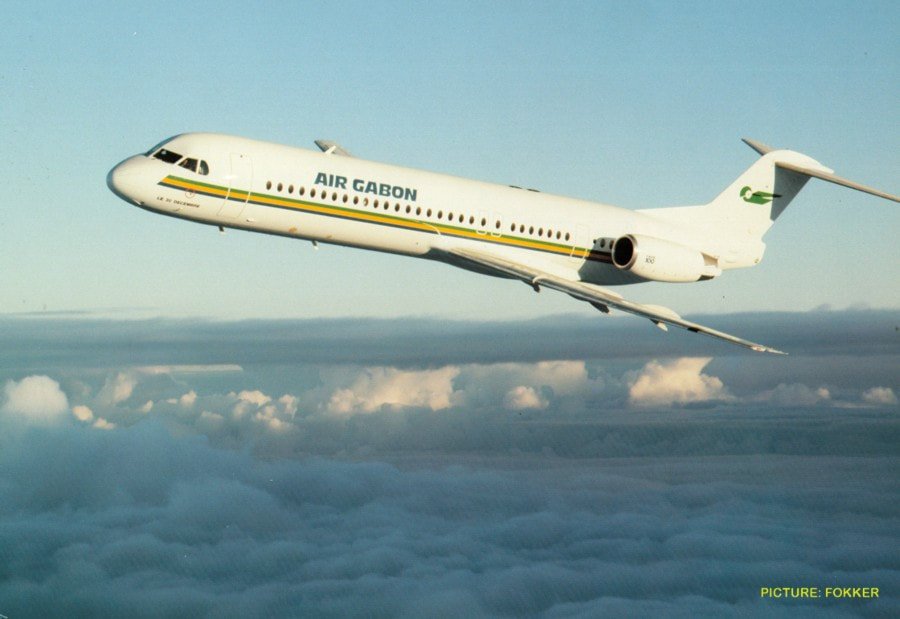
A single Fokker 100 was leased from GPA as TR-LCR between December 1989 and June 1994.
Out of 1,900 company employees, 900 were laid off. By this time the 747 had been joined by a single 767-200 (two were leased at various periods) whilst a 727 served the medium haul routes. The 737-200 remained but all the Fokkers had either been withdrawn or repossessed, including a single Fokker 100. At various times in the 90s other 727s and a 757 were leased in.
This ex-Air France 727 became TR-LEV and served between May 1993 and 2001. Perry Hoppe [GFDL 1.2 (http://www.gnu.org/licenses/old-licenses/fdl-1.2.html) or GFDL 1.2 (http://www.gnu.org/licenses/old-licenses/fdl-1.2.html)]
Gabon itself was forced to undertake a structural adjustment programme by the IMF and World Bank and part of this forced them to withdraw the subsidy that helped the airline balance its books. Somewhat ironically the government as Air Gabon’s biggest customer actually owed it 11 billion CFA – surely a case of circular financing.
The 747 remained in service into the 2000s. Aldo Bidini [GFDL 1.2 (http://www.gnu.org/licenses/old-licenses/fdl-1.2.html) or GFDL 1.2 (http://www.gnu.org/licenses/old-licenses/fdl-1.2.html)]
Somehow despite the threat of imminent collapse the airline carried on despite the fleet being increasingly obsolete. There was a sprinkling of renewal with both a 737-300 and 400 joining in the early 2000s, although the former was written off in a runway overrun in December 2003.
By August 2004 things were bad enough that the airline was looking to sell the 747 to try and pay a portion of its debts. Maintenance of the aging 747 accounted for about half of the airline’s maintenance expenses and increased its debt to Air France, which serviced the Air Gabon fleet.
767s like TR-LFH tookover the 747's routes in 2004. This aircraft was ex-Egyptair and served between 1998 and 2006. Konstantin von Wedelstaedt [GFDL 1.2 (http://www.gnu.org/licenses/old-licenses/fdl-1.2.html) or GFDL 1.2 (http://www.gnu.org/licenses/old-licenses/fdl-1.2.html)]
At around this time the 747 was withdrawn, or impounded, and stored at Paris CDG. The 767 took over long-haul services for a time before they were suspended. The final collapse of Air Gabon occurred on March 3, 2006 and photo evidence shows that F-ODJG was broken up less than a month earlier.
The eventual and long-coming failure of Air Gabon mirrors the collapse of several other smaller African flag carriers, which failed more due to poor administration and management rather than their viability. Certainly the 747, as a Combi variant, seems to have been broadly profitable for Air Gabon, but its dutiful service across more than 20 years could not alone save Air Gabon from itself.